 As a worker, your two most important tools are your hands. Unfortunately, those two vital tools suffer through a great deal of wear and tear. On the worksite, your hands might be exposed to harsh weather conditions, dirt, chemicals, fuels, grease, solvents, oil and other unforgiving substances. Plus, if you’re handling sharp tools and heavy equipment constantly, you’re putting your hands at risk every day on the job.
For more information on how to keep Workers Compensation claims low, contact us today!
Read more

Scurich Insurance Services, is giving away a Amazon Kindle with 3G & Wi-Fi!
Click Here to enter to win Today!
320 East Lake Avenue, PO Box 1170
Watsonville, CA 95077-1170
Office: 1-831-722-3541
Toll Free: 1-800-320-3666
Read more

As the economy begins to grow again, businesses will start to add workers to their payrolls. This is good news for those workers and for the economy, but statistics show that the first year on a new job is also very risky to the workers’ health. The U.S. Bureau of Labor Statistics reported that 41% of work-related injuries occur each year to workers who have been on the job for less than a year. On top of that, younger employees get hurt on the job more often than do their older colleagues. A National Institute for Occupational Safety and Health study showed that workers under age 24 are twice as likely as older workers to have non-fatal workplace accidents. In addition to the pain and suffering these workers endure and the disruption to their lives, employers face increased Workers Compensation costs. Therefore, preventing new employees’ accidents should be a top priority for all employers. There are several things employers can do toward that end.
Review and update job descriptions. If management has not compared job descriptions to the actual work being done recently, this is the time to do it. Work tasks are changing constantly as new tasks take priority, old tasks become less important, and technology changes how workers perform current tasks. Without a clear understanding of how employees are performing their work (or, more importantly, how they should be performing it,) managers will be unable to train new employees effectively or to determine why they are getting hurt and how to keep Workers Compensation claims down.
Conduct training programs that require the employee’s active participation. When people learn how to drive, they do not just watch a video or listen to a lecture about which pedal is the brake and which is the accelerator. They get behind the wheel and actually drive. Safe job performance works the same way. An employee will retain the knowledge far better if he watches a demonstration and then performs the tasks in a safe, controlled environment.
Closely supervise new employees. Interactive training alone will not guarantee safe work performance and help to keep Workers Compensation claims low. Supervisors should pay close attention to new workers during their first days and weeks on the job to make sure that they are using the knowledge gained during training and not falling into bad habits. Pointing out unsafe practices and correcting them quickly should instill good habits and make working safely an automatic part of the employee’s routine. Ideally, the employee should need less supervision the longer he is on the job without injuring himself or others.
Every day in business, competition becomes more fierce; only high-value, low-cost providers of products and services can thrive. A company gains an edge by attracting and retaining excellent workers and by holding down variable costs. Preventing workplace injuries does both. By making the effort to keep all employees, especially new employees, safe, the company will develop a reputation as a good place to work and reduce Workers Compensation costs, adding dollars to the bottom line. Businesses should view workplace injuries as a preventable expense that they do not have to accept.
Read more

Scurich Insurance Services, is giving away a Amazon Kindle with 3G & Wi-Fi!
Click Here to enter to win Today!
320 East Lake Avenue, PO Box 1170
Watsonville, CA 95077-1170
Office: 1-831-722-3541
Toll Free: 1-800-320-3666
Read more
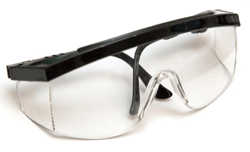 Your eyes are constantly at risk on the jobsite — whether you work in a manufacturing plant, a lab, or a construction site. Some studies show that about 2,000 eye injuries take place each and every day and Workers Compensation claims skyrocket. Sadly, 10% to 20% of these eye injuries result in temporary or permanent vision loss.
Perhaps even more eye-opening is this statistic: Three out five people who suffer from eye injuries were not wearing eye protection when the accident occurred. If you want to shield your eyes from harm on the worksite, read on to learn more about jobsite eye injuries and how to prevent them with the proper protective eye wear.
The Usual Suspects: Common Causes of Eye Injuries
Although there are countless causes for jobsite eye injuries, some of the most common offenders are:
- Flying objects: About 70% of jobsite eye injuries are caused by flying debris or falling objects, according to a Bureau of Labor Statistics Survey.
- Chemicals: Many injuries are the result of eyes coming into contact with dangerous chemicals.
- Negligence: Poor maintenance, substandard safety habits, the misuse of tools, and improper eye protection result in a great deal of eye injuries.
Eye Protection 101
It is extremely important to choose the right eye protection for your specific job. The Occupational Safety and Health Administration (OSHA) requires that employers provide workers with suitable eye protection. Some workers might need to use a different type of eye protection from day to day or even hour to hour as their duties change. Here are the different types of eye protection available to workers:
- Goggles: If you work around a lot of liquid pesticides, toxic chemicals and/or dust, goggles might be your best option. They provide better protection against splashes and dust than safety glasses. Make sure that the goggles fit tightly against your face for the ultimate protection. This will reduce Workers Compensation claims.
- Glass eye protection: Not only are glass lenses less likely to scratch, but they can withstand chemical exposure as well as protection from flying objects. Additionally, if you have vision problems, you can get prescription lenses.
- Plastic and polycarbonate eye protection: These eye protection products are generally lightweight and protect well against welding splatter. Although they are less likely to fog up, plastic and polycarbonate products are not very scratch resistant and do not accommodate prescriptions.
- Shielded safety glasses: If you job requires safety glasses, make sure to choose shielded safety glasses. Shields will offer your eyes more protection from flying debris as well as chemicals suspended in the air.
- Full face shields: If you work in an environment where you could be exposed to an airborne substance, you should wear a full face shield. However, a face shield alone is not enough to protect your eyes — wear approved safety glasses beneath the shield.
For more information on different ways to keep Workers Compensation claims down, visit our website today!
Read more

Do you use your personal car for business? Do you have access to a company car? If the answer to either question is yes, you could have potential coverage gaps.
Example. Let’s say you use your personal car for business. It’s possible your employer is providing some coverage for you through your employer’s commercial auto policy. In most cases the coverage is for liability only, and often this commercial auto policy doesn’t even apply until the limits on your personal auto policy are exhausted. (This is what insurance people call “excess” coverage.)
You should talk to your employer about what, if any, coverage is available to you through the company’s Commercial Auto Insurance. That way, if you have an accident while on company business, you know who (or which insurance company) to call.
If you use your personal car for regular business purposes – trips, visiting clients, etc. – your personal auto policy probably provides enough coverage for these activities. (Assuming you have “enough” coverage to begin with.)
But what if your car is actually a source of revenue? You make deliveries, for example. In that case, you likely need a Commercial Auto Insurance policy as well.
If you have an accident while delivering a product or using your car as a taxi, your personal auto insurer may deny your claim. Talk to your agent to make sure you have coverage for all the business activities for which you use your car.
What about company cars? They can be an insurance problem, if you use the company car for business and pleasure, particularly if you don’t have a car of your own. If you don’t have a car, you probably don’t have a personal auto policy. If you don’t have a car (or personal auto coverage) and use a company vehicle for pleasure, you are inviting disaster if you have an accident during a pleasure trip.
If you are in this situation, you should have what is called a non-owned personal auto policy.
Such a policy can also come in handy if you don’t have a car and you rent a vehicle on a trip. Your non-owned auto policy will cover you and your rental car if you have an accident. Otherwise, you would probably need to buy coverage from the rental car company, coverage that is very, very expensive.
You can have coverage gaps even if you have a personal auto policy and use a company car for pleasure or if your spouse or children use the company car for pleasure. Find out from your employer the extent of coverage that is available for your corporate car. Once you know the extent, talk to your insurance agent about any additional coverage you might need.
For more information on Commercial Auto Insurance, please visit our website today!
Read more
