
Why is job safety and health important?
In 2013, 4,585 employees died from occupational incidents, and there were a staggering 3.0 million total recordable cases of workplace injury and illness.
On average, each of these 3.0 million cases required eight days away from work, which means U.S. employers as a whole paid for millions of days of lost work time. Experts estimate that workplace injuries and illnesses cost U.S. businesses more than $125 billion annually. Effective job safety and health programs not only help reduce worker injuries and illnesses, they save employers money in the long run.
How does OSHA contribute to job safety and health?
The primary goal of the Occupational Safety and Health Administration (OSHA) is to carry out the Occupational Safety and Health Act (OSH Act), which Congress originally passed in 1970. The OSH Act has undergone several amendments and revisions since its inception, but it is still in place “to assure so far as possible every working man and woman in the Nation safe and healthful working conditions and to preserve our human resources.” OSHA contributes to job safety and health by enacting regulations that forward this ideal.
Title 29 of the Code of Federal Regulations (CFR), Parts 1902-1990, houses all the OSHA standards, though OSHA also allows states to enact occupational safety and health laws of their own under federally-approved plans. State-run programs are at least as strict, and sometimes more so, than federal standards. This ensures a minimum standard of job safety and health that all employers must follow to protect employees.
Are all employees covered by the OSH Act?
The OSH Act covers all employees except public employees in state and local governments and those who are self-employed. Public employees in state and local governments are covered by their state’s OSHA-approved plan, if applicable.
Federal employees are covered under the OSH Act’s federal employee occupational safety and health programs, which are outlined in 29 CFR Part 1960. United States Postal Service employees, however, are subject to the same OSH Act coverage provisions as those in the private sector.
Other federal agencies that have issued requirements affecting job safety or health include the Mine Safety and Health Administration (MSHA) and some agencies of the Department of Transportation (DOT), including the Federal Motor Carrier Safety Administration (FMCSA). Employees in these industries are subject to their respective regulations.
Additionally, businesses in the retail, service, finance, insurance and real estate sectors that are classified as low-hazard are exempt from most OSHA requirements, as are small businesses with 10 or fewer employees. Exceptions are discussed in 29 CFR Part 1904, which also explains which OSHA regulations exempt employers are still required to follow.
What are your responsibilities as an employer?
If you are an employer covered by the OSH Act, you must provide your employees with jobs and a place of employment free from recognized hazards that are causing, or are likely to cause, death or serious physical harm. You must also comply with the OSHA statutory requirements, standards and regulations that require you to:
- Provide well-maintained tools and equipment, including appropriate personal protective equipment (PPE)
- Provide medical assistance and guidance for employees sustaining workplace injuries/illnesses
- Provide required OSHA training
- Report accidents that result in fatalities to OSHA within eight hours
- Report accidents that result in the hospitalization of three or more employees to OSHA within eight hours
- Keep records of work-related accidents, injuries, illnesses and their causes
- Post annual injury/illness summaries for the required period of time
What are your rights as an employer?
When working with OSHA, you may do the following:
- Request identification from OSHA compliance officers
- Request an inspection warrant
- Receive a reason for inspection from compliance officers
- Have an opening and closing conference with compliance officers
- Accompany compliance officers on inspections
- Request an informal conference after an inspection
- File a notice of contest to citations or proposed penalties
- Apply for a variance from a standard’s requirements under certain circumstances
- Be assured of the confidentiality of trade secrets
- Submit a written request to the National Institute for Occupational Safety and Health (NIOSH) for information on potentially toxic substances in your workplace
What are employees’ responsibilities?
All employees are obligated to help prevent exposure to workplace safety and health hazards by becoming familiar with and adhering to all applicable OSHA requirements.
What are employees’ rights?
With regards to OSHA regulations, employees have the right, among other actions, to:
- Review employer-provided OSHA standards, regulations and requirements
- Request information from the employer on emergency procedures
- Receive adequate, OSHA-required safety and health training on toxic substances and emergency action plan(s)
- Ask the OSHA area director to investigate hazardous conditions or violations of standards in the workplace
- Have his or her name withheld from the employer when filing a complaint with OSHA
- Know what actions OSHA took as a result of the employee’s complaint and have an informal review of any decision not to inspect or issue a citation
- Have an employee representative accompany the OSHA compliance officer on inspections
- Observe monitoring and measuring of toxic substances or harmful physical agents and review related records (including medical records)
- Review the Log of Work-Related Injuries and Illnesses (OSHA 300 Form), if applicable, at a reasonable time
- Request a closing discussion following an inspection
- Object a citation’s set abatement period
- Seek safe and healthful working conditions without your employer retaliation
Why is OSHA important to your business?
OSHA plays a key role in making your facility a safe, healthy place to work. Beyond providing the tools and guidance to work toward an injury- and illness-free workplace, OSHA is important in identifying businesses that are not committed to safety. Employers that do not carefully follow OSHA regulations often face hundreds of thousands, if not millions, of dollars in fines.
How can you get more information on safety and health?
OSHA provides free publications, standards, technical assistance and compliance tools to help you understand the nuances of the regulations. OSHA’s website also offers extensive assistance by way of workplace consultation, voluntary protection programs, grants, strategic partnerships, state plans, training and education to guide you in your quest for workplace safety. To learn more about OSHA and the critical elements of a successful safety and health management system in your workplace, visit www.osha.gov.
This document is an introductory guideline. It does not address all potential compliance issues with OSHA standards. It is not meant to be exhaustive or construed as legal advice. Contact your licensed commercial property and casualty representative at Scurich Insurance or legal counsel to address applicable compliance requirements. © 2009-2012, 2015 Zywave, Inc. All rights reserved.
Read more
 Injured workers who gain weight due to inactivity or as a side effect of medication will probably receive higher workers comp benefits, thanks to the American Medical Association’s recent reclassification of obesity as a disease. That’s the conclusion of a recent six-year study of claims by the California Workers’ Compensation Institute.
According to the report, although this reclassification doesn’t have legal standing, the AMA’s positions often have a strong influence on lawmakers, regulators, and health care providers. Immediately after the decision, senators and congressmen introduced bipartisan bills requiring Medicare to cover more obesity treatment costs, including prescription drugs and intensive behavioral weight-loss counseling, which will give health care providers a financial incentive to use these remedies.
Judging from the results of the California study, this means that businesses can expect to pay more for workers comp. The report found that the costs of comp claims that listed obesity as a “comorbidity,” or additional cause, were far greater than for claims without them. Medical benefits for comorbidity cases cost 81% more than for other cases, while indemnity payments averaged nearly 65% higher. More two in three claimants with obesity comorbidity received permanent disability, nearly five times the rate for the non-obese. Finally, the use of narcotic painkillers was significantly higher among overweight claimants.
Obesity might even become a primary comp diagnosis for jobs such as long-haul trucking or office work that require employees to remain seated for extended periods.
The bottom line: look for the management and financial changes stemming from the reclassification of obesity as a medical condition to create new challenges and incentives for health care professionals, businesses, and workers compensation insurance companies.
We’ll stay on top of these changes to help make sure that your company has the coverage you need at a competitive rate.
Read more

The number of mid-market employers giving Group Health plan members incentives to participate in wellness programs has more than doubled since 2010, says a recent report by Fidelity Management and Research L.L.C.
The study found that more than three in four midsize businesses (77%) – those with fewer than 5,000 employees – offered employees monetary rewards tied to wellness activities and health management outcomes in 2011, compared with fewer than two in five (38%) that provided cash incentives in 2010. Overall, nearly nine in ten employers surveyed (86%) gave some type of incentive for wellness activities and/or outcomes in 2011, up from with 63% a year earlier.
The average value of incentives offered to employees and their dependents has also increased substantially. For the 2013 plan year, the average employee incentive value will reach $521, up from $460 in 2011; while the average incentive value for dependents will grow to $465 this year, from $390 in 2011.
Despite the rapid increase in mid-market businesses offering incentives for wellness program participation, they’re still less likely than larger employers to provide these rewards. The value of incentives also remains lower among midmarket employers than those given by larger businesses. Less than half of midsize firms (45%) offered inducements for healthy behavior worth $500 or more, compared with 50% of large employers and 68% of very large employers.
“As the cost of providing health care continues to increase, employers recognize one of the key ways to manage their company’s costs is to give incentives to their workforce for leading a healthier lifestyle,” says Adam Stavisky, Fidelity Senior Vice President/ Benefits Consulting.
If you’d like to implement, or a revise, an incentive program to help keep your workers stay more healthy – and, thus, more productive – just let us know. We’re here to help!
Read more
 I recently responded to the LinkedIn question “How can a company attract and maintain top talent?” in this way:
“Although you’ll get many responses about technique and strategy, in my experience that’s just the beginning of the answer. There’s a significant emotional aspect to the question. In the words of the Buddha, “What comes to you comes from you.” So that’s what I’ll focus on in this answer; the emotional blockages that stop things from coming to you. Ask yourself these questions:
- Are you really willing to do what it takes to attract and keep great talent?
- Are you willing to hire somebody better than you? Or even better than their manager?
- Does driving towards excellence scare you? Are you prepared to hire the top 10%?
- Would you fit in this category?
- Is there such a thing as an “overqualified” applicant?
- Are you open to hiring and managing different types of people? Can you hire without baggage?
- Do you make a conscious effort to show people you care – or is this just your self-talk?
- Do you allow employees to make a difference? To stretch? To find the good in their work?
- Do you let go of poor performers, thus making room for more good ones?
- Does leadership give a hoot about people, or simply growing their bottom-line?
- Is this a fun place to work or is the attitude that fun and work don’t mix?
Most importantly, think about your own experience. Why would you work somewhere or stay there? “
Read more
 In the California case, Richie v. AutoNation, an employee out on CFRA (FMLA) was fired by his employer when he was found to have been working at a restaurant he owned during his leave period. The company’s leave policy prohibited outside employment during leave. The court ruled in favor of the plaintiff, stating that FMLA/CFRA (the California equivalent) has a process to follow in shortening FMLA leave if you believe that an employee no longer qualifies for it. You cannot create your own rule or process and, in a sense, do an end run around FMLA protections. The court ruled that because job reinstatement is mandatory, the only way to stop leave properly is by following the CFRA process and questioning the medical opinion of the employee’s doctor.
This decision reminds us that ignorance of legal requirements is no excuse. In this case, the company argued that it had a good faith defense because it was not aware of this limitation on managing leave. The court essentially said “So what? It’s a mandatory statutory obligation, which you can’t avoid.” As a different court stated, “A showing that an employee is unable to work in the employee’s current job due to a serious health condition is enough to demonstrate incapacity. The fact that an employee is working for a second employer does not mean that he or she is not incapacitated from working in his or her current job.”
Some additional notes:
- The decision reminds us that an employer’s policy on secondary employment during FMLA leave must be the same as that for employees who are not on FMLA leave. Otherwise, the policy itself violates the law.
- Second, the court overturned an arbitration decision in this case which allowed the court’s good faith defense. Although review of arbitration is very limited, the court will step in if the arbitrator misapplied the law.
- Finally, whether it’s FMLA leave, ADA accommodation leave, use of PTO or sick pay, etc., if you doubt the veracity of any employee’s story (i.e. they were playing soccer or lifting pianos this weekend), you must follow the proper procedures so that you don’t find yourself trapped like AutoNation did in this case.
Read more
In a recent HR webinar, I asked three highly revealing polling questions. Here they are:
- What have you done to show your value?
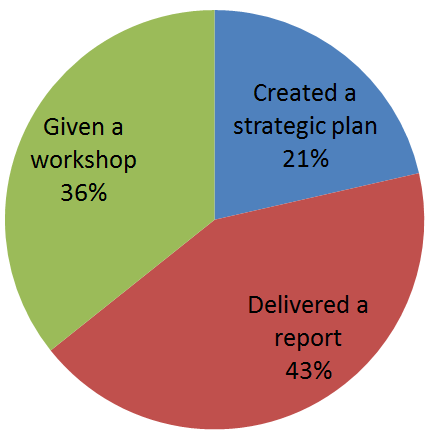 Nobody knows that you’re doing a great job unless you tell them. It’s not that they don’t care about you; it’s just that they’re running 75mph and barely have time to pay attention to anything but their own work. What effort have you made to get noticed by delivering a report or giving a workshop? Unfortunately, only 21% of respondents said that they created a strategic plan. As Mary Kay once stated, “most people spend more time planning their vacations better than their career.” Or, as I might add, their HR department.
- How excited are you about the HR opportunity on a scale from 1-5 (5 being very excited)?
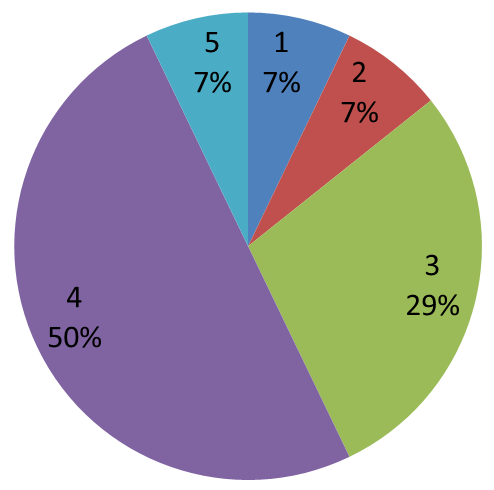 Half of the respondents described themselves as fairly “excited.” Unfortunately, some 43% were just “ok or worse” with HR. Most organizations find the whole idea of HR boring. My guess is that is not the case at the 7% of companies where people said they were very excited about HR! I believe that if 7% can be excited, so can the 93%. It’s simply a choice. What have you done in HR lately that goes beyond administrative or compliance requirements? What have you done to help improve the quality of the workplace (getting rid of poor employees and replacing them with great ones is a start), increasing performance management (having a performance management system that actually works), boosting retention, and giving greater love to that 20% of your workforce that produces 80% of results? What are you helping your company do to become more creative, innovative, and interesting?
- What’s stopping you?
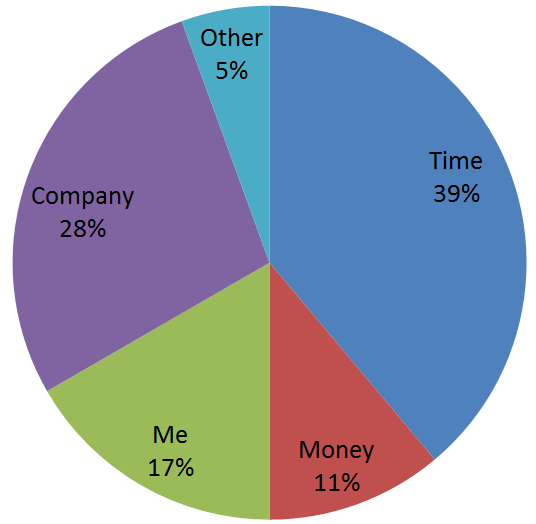 I often ask this question in workshops and in webinars. Time is always the most common response (one of those buts again), followed by the company or management. A survey of HR That Works members found that 84% of respondents said they would make better use of the service if they had more time.
Time management is a major issue!
Go to the time management training on HR That Works. Watch the two videos and then start putting them into practice. I would recommend that you start by tracking where your time is going and then eliminate five hours of the uncool, un-valuable work you do every week.
Read more
