
Taking the time to understand the language and symbols on your commercial automobile insurance policy may seem like trying to learn a new language, but it is important to fully understand your policy so you know how you’re protected.
Here are a few general guidelines that are helpful when deciphering your policy:
- Each symbol represents the type of vehicle protected by the applicable liability or physical damage limit.
- The symbol may apply to the type of vehicle covered or the vehicle’s ownership status.
- The various terms within your policy have specific definitions that you should become familiar with.
- The symbols are different on coverage for liability as compared to physical damage coverage.
Liability Coverage Auto Symbols
1 = Broadest symbol; covers any “auto.” (ANY AUTO)
2 = Covers any “auto” owned by the insured, including those attained after the policy begins. It also applies to trailers used with owned vehicles. (OWNED AUTOS ONLY)
3 = Covers only private passenger “autos” owned by the insured. (OWNED PRIVATE PASSENGER AUTOS ONLY)
4 = Covers all “autos,” other than private passenger vehicles owned by the insured. This includes vehicles that are attained after the policy begins and also applies to trailers used by an owned vehicle. (OWNED AUTOS OTHER THAN PRIVATE PASSENGER AUTOS ONLY)
5 = Applies to “autos” owned by the insured that are garaged or licensed in no-fault benefit law states. (OWNED AUTOS SUBJECT TO NO-FAULT)
6 = Applies to “autos” that are garaged or licensed in states where uninsured motorist coverage is required. (OWNED AUTOS SUBJECT TO A COMPULSORY UNINSURED MOTORIST LAW)
7 = Covers only the “autos” and trailers listed on the policy. (SPECIFICALLY DESCRIBED AUTOS)
8 = Covers “autos” that the insured leases, hires, rents or borrows for their own use. It does not cover “autos” that are leased, hired, rented or borrowed for employee or family member usage. (HIRED AUTOS ONLY)
9 = Covers “autos” that the insured does not own, lease, hire, rent or borrow, but are used for business purposes. These “autos” may be owned by employees or family members, but must be used for the insured’s business or personal matters. (NON-OWNED AUTOS ONLY)
Physical Damage Coverage Automobile Symbols
1 = Covers “autos” owned by the insured, including those attained after the policy begins. (OWNED AUTOS ONLY)
2 = Covers only private passenger “autos” that are owned by the insured. (OWNED PRIVATE PASSENGER AUTOS ONLY)
3 = Covers all “autos” other than private passenger vehicles owned by the insured. (OWNED AUTOS OTHER THAN PRIVATE PASSENGER AUTOS ONLY)
4 = Applies to “autos” that are listed on the policy. This also covers trailers used with a listed vehicle. (SPECIFICALLY DESCRIBED AUTOS)
5 = Covers “autos” that the insured leases, hires, rents or borrows for his/her own use. This does not cover “autos” leased, hired, rented or borrowed for use by an employee or family member. (HIRED AUTOS ONLY).
At times, there may not be an applicable symbol for the type of coverage provided. In those instances, a special symbol is used and added to the policy by way of an endorsement. The endorsement will contain a complete description and explanation of the symbol’s meaning, and the symbol will also appear with the applicable coverages on the policy.
It is imperative that you understand these symbols to ensure that you are properly covered. Consult Scurich Insurance today to learn more automobile insurance policy symbols, their meanings and how this applies to your coverage.
Read more
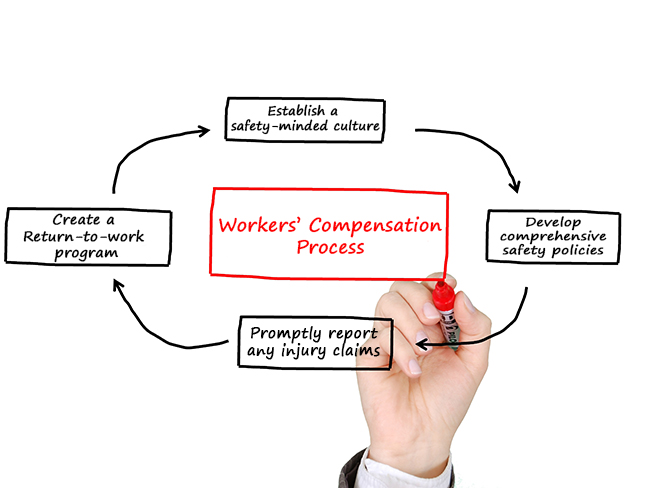
For the unprepared, workers’ compensation (WC) issues can be both confusing and costly. Fortunately for employers, there are ways to actively engage WC issues to influence their outcomes.
Through management controls and active involvement in the WC process, your organization can effectively influence related costs. To do so you will have to establish a number of your own processes that guide decision making throughout your organization.
By developing a cohesive workers’ compensation process, you can play an active role in reducing related costs.
Areas requiring WC management can be divided into three main categories. These categories include facets that may range from the simple to the complex, but as a whole, address vital issues that can negatively influence WC costs in your company.
Workplace Safety Means Fewer Claims
Simply put, reducing claims reduces costs. Establishing a safety-minded culture throughout every level of your company is essential to keeping workers injury free. However, establishing such a culture isn’t an overnight solution. To be successful, an ongoing commitment to safety must be made. Such a commitment must be supported by management and given the necessary resources to succeed.
Developing comprehensive safety policies for employees builds a firm foundation for your safety culture to grow. Such policies also encourage OSHA compliance, further improving your safety efforts while helping you avoid costly fines.
Mitigate Loss After an Injury
Unfortunately, even with all the right programs in place, it is still possible for accidents to happen. When a workplace incident occurs how you respond can greatly influence the outcome of the claim. Prompt claim reporting is essential to keeping costs down.
It is also important to have a designated injury management coordinator, someone who can supervise open claims and work with both employees and medical personnel to facilitate the timely recovery.
The longer an employee is out of work the more expensive their claim will be. Return-to-work programs that allow injured employees to come back to work at a limited capacity during the recovery process, are one of the most effective tools business owners have to reduce the severity of a claim.
Managing Your Mod
Insurers use what is known as an experience modification factor, or mod, to calculate the premiums you pay for workers’ compensation coverage. By managing your exposures and promoting safety it is possible to manage your mod and decrease your premium rates.
Like a good safety program, controlling your mod is an ongoing process. To reap the benefits of lower premiums you will have to keep in regular contact with your insurance provider to ensure they have the most accurate data to use in their calculations.
Read more

In the event that someone is injured on your property and you are found legally responsible, you could be faced with a costly financial burden. In fact, without a personal umbrella liability insurance policy, any expenses beyond the limits of your standard policy are your responsibility. This applies to your homeowners, renters, automobile and watercraft insurance policies.
Personal umbrella liability insurance provides an extra layer of protection over your personal assets for when your standard liability coverage is exhausted.
Engaging in everyday activities can put you at risk for a lawsuit. Simple things like having a swimming pool or entertaining guests in your home can increase the chance that someone will get injured and sue you. To minimize your risk, consider a personal umbrella liability policy.
Why is a personal umbrella liability policy important? It works to fill the gaps in your coverage and provides the following benefits:
- When litigation ensues, it’s typically for a large amount. If you get into a car accident and injure several people, you could be sued for millions of dollars; well beyond the limits of your automobile policy. You can also be held responsible if your dog bites someone, if your child injures another kid in a fight at school or if a handyman hurts himself at your home.
- Umbrella policies cover legal fees because the insurance company assumes the risk, not you.
- Coverage is inexpensive and easy to obtain. Just give us a call to add it on to your current policy.
- You’ll have peace of mind knowing that you are covered in case of a fluke occurrence.
How much coverage do you need? Take into consideration your total personal assets and your potential for personal risks when determining how much coverage you need.
A wide range of factors, such as whether you have hired help, if you have teen drivers at home or if you operate your business out of your home, will determine how much coverage is appropriate for your circumstances.
What are the policy limits? A $1 million limit is typical and higher limits are available.
Contact us today to determine how much coverage is right for you.
Read more

The Virginia Graeme Baker Pool and Spa Safety Act addresses dangers related to pool and spa drains, which can cause severe injury or death by trapping swimmers under the water when blocked. The Act is designed to improve pool and spa safety through new federal requirements for drain covers and anti-entrapment systems as well as by establishing educational programs.
Federal Requirements
The Act contains the following federal standards for swimming pool and spa drain covers:
Your business should follow all pool and spa safety requirements to lower risk.
- All covers manufactured, distributed or sold in the United States must conform to the specified entrapment protection standards.
- All must be equipped with anti-entrapment devices or systems that comply with the same federal standards.
- Each public pool and spa in the country with a single main drain (other than an unblockable drain) must be equipped with at least one device or system designed to prevent entrapment, such as a safety vacuum release system, suction limiting vent system or gravity drainage system, that meets appropriate performance standards.
The requirements contained in the act are intended to be minimum standards; many states have more rigorous safety rules. Violations of the act’s requirements will be treated as violations of the Consumer Product Safety Act.
State Swimming Pool Safety Grant Program
A grant program exists that provides financial assistance to states that have minimum safety requirements for pools and spas that meet the standards contained in the Act. The state statute must require pool and spa owners to:
- Enclose all outdoor, residential pools and spas with barriers to prevent small children from gaining unsupervised access to the area
- Equip all pools and spas with anti-entrapment devices
- Equip all pools and spas built after Dec. 19, 2008 with more than one drain, one or more unblockable drains, or no main drain with anti-entrapment devices
- Equip every swimming pool and spa that has a main drain with a drain cover that meets standards
In addition to imposing these safety requirements, the state law must require periodic notification to owners about compliance with the entrapment protection standards. States can use the grants for the following purposes:
- Hiring and training enforcement personnel for implementation and enforcement of the state laws
- Educating pool construction, installation and service companies about the safety standards
- Educating pool owners, pool operators and other members of the public about the safety standards
Education Program
The act also established an education program to inform the public of methods to prevent drowning and entrapment in swimming pools and spas. The educational materials are designed for pool owners and operators to promote safety.
Please contact Scurich Insurance at (831) 661-5697 with any questions regarding risks and liabilities associated with your business’ pool or spa.
Read more

In today’s high-tech world, individuals can carry thousands of client files on flash drives in their pockets or purses. People are conducting business on the go and sensitive information is accessible at the click of a button. Managers are using their laptops or tablets through “hot spots” at local coffee shops to access customer databases. Healthcare professionals shopping at supermarkets can get patient files on their smartphones.
If you think of information security breaches primarily in terms of malicious hackers cracking the networks of big corporations from thousands of miles away, think again.
The hacking of such corporate giants as Global Payments, Epsilon, and Sony prove that size and sophistication can’t stop data thieves. However any company that stores customer information in electronic format is vulnerable to cyber privacy liability exposures than can cost megabucks – or even put a firm out of business – which means they need insurance against these risks.
Cyber Liability coverage can protect your business against breaches of privacy from unauthorized access, physical taking, or the mysterious disappearance of confidential information that leads to third-party losses resulting from identity theft.
Depending on your needs, the policy can also provide a variety of coverages, such as:
- Business Interruption
- Cyber Extortion
- Systems and Data Recovery
Other options can cover the cost of contacting those affected by the data breach, computer forensics to analyze the breach, fines and penalties, potential HIPAA (client medical records) exposures, and online activities on your company site.
The development and expansion of Cyber Liability coverage during the past two decades has paralleled the explosive growth of computer technology: Today’s policies are increasingly comprehensive – and inexpensive. Contact us today to discuss your Cyber Liability Insurance needs.
Read more

If an employee is away, restricted or transferred for an extended period of time, follow these guidelines for completing the OSHA 300 form:
- Enter an estimate of the days the employee will be away.
- Begin counting days on the day after the injury occurred or the illness began, and update this number when you know the actual number of days.
- The count of days away from work ends on the date the physician or other licensed health care professional recommends that the employee return to work, whether or not the employee returns earlier or later than that date.
- When there is no physician recommendation, enter the actual number of days the employee is off work.
- Include weekend days, holidays, vacation days or other days off in the number of days recorded if the employee would not have been able to work on those days due to a work-related injury or illness.
- When the number of calendar days away from work or days of job transfer or restriction is greater than 180, enter 180 in the “Total Days Away” column.
- If an employee leaves the company for a reason unrelated to the injury or illness, stop counting days away from work or restriction/job transfer.
- If an employee leaves the company because of the injury or illness, estimate the total number of days away or days of restriction/job transfer and enter that estimate.
- Log the number of days away only on the 300 Log for the year in which the incident occurred.
- If the employee is still away from work because of the injury or illness when you prepare the annual summary, estimate the total number of calendar days you expect the employee to be away from work, use this number to calculate the total for the annual summary and then update the initial log entry later when the day count is known or reaches the 180-day cap.
- Never split the number of days between years and enter two amounts for two different years. Only record each injury or illness once.
Read more
