
It is obvious that farming can be a dangerous profession, but those working in the commercial hog farming business are exposed to particularly hazardous situations on a daily basis. As a hog farm employer, you need to continually analyze your risks to keep your business afloat. These risks not only include the health and safety of your employees, but also the physical condition of your product, which is crucial to maximizing your profits.
Keep Your Hogs Healthy and Profitable
One of the biggest risks when farming any type of animal commercially is ensuring they stay healthy so you can stay in business. Efficient operations increase profitability by reducing the spread of disease and integrating operations; however, small operations can also turn a profit by specializing in a single stage, keeping hogs healthy and raising them humanely.
As an employer, you must understand the nature of your exposures and exactly how they happen in order to prevent them from occurring at your facility.
Depending on what kind of business you run—whether it is farrow-to-finish, growing, wean-to-finish, breeding, large or family-run—your risks will change. Most of these hazards you are already aware of and take protective measures to prevent, but there are a few common sources of loss that may be overlooked.
Minimize transport loss. A recent Iowa State University study looked at more than 2 million hogs and found that more than 17,000 of them had the potential for reduced value at the processing plant because of carelessness during the transporting process. The National Hog Farmer reports loss averages as high as 2.4 percent per trailer load transported to slaughter plants in the United States over the past seven years.
While this loss might seem negligible, it could accumulate into thousands of dollars in lost business and make a huge difference in a tough market. Consider training your truck drivers and loading crews more thoroughly to emphasize gentleness of starts and stops and proper handling in the sorting, moving and loading process. Also, ensure that your trailers maintain an acceptable temperature and have suitable ventilation even when the vehicle is stopped.
Emphasize disease control. Improperly managed manure removal systems could cost you money in the form of dwindling health of your hogs. Manure buildup in barns holds the possibility for disease, especially Escherichia coli (E. coli), which is particularly fatal in piglets.
Maintain good hygiene and proper temperature control in farrowing crates to lower your mortality rate and increase productivity and profit. In addition, better hygiene leads to healthier hogs, and healthier hogs gain weight more quickly and easily than those exposed to manure buildup and noxious odor. You might consider looking into technological innovations in hog waste and lagoon management systems to help. Between 5 and 10 percent of U.S. hogs are removed from the industry every year because of death and disease, so it is important to stay ahead of your competition by implementing good, healthy practices.
Avoid unsound contracts. Farming is a dangerous occupation, and it is also an unpredictable one. If you depend on outside resources for corn, soybeans, water and medications, make sure these inputs will always be available. Feed inputs can suddenly be in short supply because of bad weather or because of competition from other non-feed harvests. Enter into solid business contracts with these providers to guarantee plenty of supplies for your anticipated number of pigs and hogs.
Keep Your Employees Healthy and Productive
Just as keeping your hogs and pigs healthy is crucial to your business, ensuring your employees are able to work and that they are in a good environment will also help you stay in business and turn a better profit. There are three major employee health concerns specific to the hog farming industry that you should work to avoid or minimize:
Respiratory problems.
According to the University of Iowa’s College of Public Health, one quarter of those working at hog farms have one or more documented respiratory problems. The most common are chronic bronchitis and asthma-like wheezing, which could both be caused by dust, endotoxin and/or ammonia exposure.
Professors at Iowa’s College of Public Health suggest using an extra one percent of oil or fat in the hogs’ diet and reducing the distance between feed drops and feeders to reduce the amount of dust in the air from feed, microbes, dried manure and pig skin cells. Require your employees to use the proper respirators if they will be working more than two hours per day in the barn.
Manure gas exposure.
Manure pits more than three feet deep that are agitated after a long period at rest release hydrogen sulfide gas, which is extremely dangerous. Consider enacting a policy that requires employees to exit the building during agitation and for the 30 minutes following in addition to requiring the appropriate personal protective equipment (PPE).
Also, it is important to empty the pit three or four times per year to reduce the amount of gas buildup. Another option is to raise the pH of the manure to keep gas from escaping the pit and potentially harming employees.
Accidental needlesticks.
ese types of incidents are far more common than expected, and the injection of chemicals meant for animals can be exceptionally dangerous to humans. Accidental needlesticks can result in several types of injuries, including inflammation, infection and hyperimmune responses. Needlesticks involving reproductive hormones can be even more hazardous for female employees, causing hormone imbalance and even miscarriages.
Instruct employees to practice caution when removing needle caps and disposing needles. Keep the proper material data safety sheets (MSDS) on file in case of a needlestick, and do not force female workers to work with hog reproductive hormones if they feel uncomfortable.
Remember that in addition to these hazards, general farming industry dangers also are present. Examples of farming risks you should bring up with employees are proper animal handling, hearing protection, proper machinery and equipment use, repetitive motion hazards, safe lifting techniques and protection against slips, trips and falls.
Be Kind to Your Neighbors
Hog farms garner lots of media attention, especially in Iowa and North Carolina, where the industry is largest. However, not all of the publicity is positive. There is growing concern among scientists that hog farm odor and byproducts could be hazardous to the environment and to people living near large operations. There have been several lawsuits recently involving neighbors of large hog farms who claim the byproducts are negatively affecting their health. Legal issues can be financially draining and negatively affect your business both at a profit level and in terms of reputation.
While there is limited evidence supporting residents’ claims that hydrogen sulfide gas omitted by large hog farms leads to serious neurological damage of people living nearby, it does not hurt to be cautious. Avoid the increasingly more common practice of spraying liquid manure into the air when the chemical levels in collection pools get too high. Regularly test the air in and around your facility for hydrogen sulfide and ammonia concentrations—the recommended standards vary by state, but they are generally around 15 parts per billion and 150 parts per billion, respectively.
In general, comply with the Occupational Health and Safety Administration’s (OSHA) standards of hazard control. Also, take additional care when disposing of chemicals and waste, and always keep the risk of litigation top-of-mind.
If you have additional questions about your exposures as a hog farm employer, contact Scurich Insurance at 831-661-5697.
Read more
Safety in your everyday small business operations is essential for your employees, customers and success. Understanding and maintaining safety guidelines can be challenging, though. OSHA offers numerous resources that benefit your company. Take advantage of these resources as you ensure your small business maintains safety guidelines and stays compliant with current laws at all times.
OSHA’s Cooperative Programs
Your small business must cooperate with OSHA to maintain safety and remain compliant with laws, but you may not know where to start. OSHA offers five cooperative programs that help your small business prevent workplace injuries, illnesses and fatalities. Available programs include:
- Alliance Program
- OSHA Strategic Partnership Program (OSPP)
- Voluntary Protection Programs (VPP)
- OSHA Challenge Program
- On-site Consultation Program’s Safety and Health Achievement Recognition Program (SHARP)
All states with OSHA-approved programs offer this cooperative program option, and you can search the website to learn more about each program.
On-Site Consultation Program
Get personalized advice with a free and confidential on-site consultation. The consultant will not give penalties or citations because the purpose of the consultant’s visit is solely to:
- Identify workplace hazards
- Share advice on how to become compliant with OSHA guidelines
- Implement injury and illness prevention programs
While the program prioritizes high-hazard worksites, it’s available to all small and medium-sized businesses and is completely free.
Diverse Workforce/Limited English Proficiency Coordinators
When your workforce employs Spanish speakers or a diverse workforce, you may need education, outreach and training assistance. Schedule a seminar or workshop with an OSHA Diverse Workforce/Limited English Proficiency coordinator. Every 10 OSHA regions has one coordinator who can help you train and prepare your employees effectively.
Compliance Assistance Specialists (CAS)
When you’re ready to host a seminar or workshop on safety challenges or compliance issues, contact a CAS. In states under federal jurisdiction, the OSHA area offices have a CAS on staff who will provide training resources and promote OSHA cooperative programs.
Training Institute (OTI) and Training Education Centers
Access a variety of OSHA trainings, including technical advice, seminar and workshop speakers, or audiovisual aids, through the Training Institute and Training Education Centers. This resource provides basic and advanced safety and health courses as well as small business seminars.
Penalty Reductions
Non-compliance with OSHA guidelines can result in large penalties. However, your small business’s size and number of employees may reduce the penalties. Learn more as you assess your eligibility for penalty reductions.
OSHA safety guidelines protect your employees and small business since they reduce injuries, illnesses and fatalities. OSHA guidelines can be confusing, though. Maintain compliance when you take advantage of these OSHA resources. They help your small business remain safe and successful.
Read more

According to a report by the U.S. House of Representatives’ Committee on Education and Labor, a staggering 69 percent of all workplace injuries and illnesses may not be represented in the Bureau of Labor and Statistics Survey of Occupational Injuries and Illnesses, which many trust as a gauge of the safety of American workplaces. On a corporate level, not reporting or underreporting workplace injuries can have serious ramifications for the organization and the employer, which can include fines, exorbitant and unnecessary, health costs and more.
Research has found that the employer’s behavior, policies and attitude are key determinants in a worker’s decision to report an injury. Not only is it essential that employees are educated on the importance of reporting injuries, it is also important to examine your company policies so you are not inadvertently discouraging reporting. The consequences of underreporting can be severe.
Consequences of Underreporting
The unfortunate trend of injury underreporting can have serious ramifications at both the industry and company level. Widespread underreporting can be quite damaging to workers’ compensation rates on a large scale. Employers may not realize it, but such an underreporting problem may lead to more audits by insurance companies of their clients and higher rates for everyone. Many employers erroneously believe that reporting injuries leads to audits and higher rates.
Underreporting may lead to more audits by insurance companies and higher rates for everyone industry-wide. Many employers believe that reporting injuries leads to audits and higher rates.
At the company level, underreporting injuries can be quite costly for the employer. If it is an OSHA-reportable incident, the employer may face significant fines if it is not properly recorded or reported.
In addition, often when an injury isn’t reported or properly cared for immediately, it worsens and leads to higher health care costs and more lost time. Even if it is never reported as a workplace injury, the employer still loses out on health care costs and productivity.
If it is eventually reported, it becomes much more difficult to prove that it was workplace-related. Additionally, a study reported by the Hartford Financial Services Group found that injuries reported four or five weeks after the incident are 45 percent more expensive than injuries reported within the first week due to increased health costs and possible legal fees, or even a lawsuit, associated with late reporting.
One of the best ways to control workers’ compensation costs is through early reporting and intervention. Not only will it save money in health bills and legal fees, but it will also help to constantly improve your safety program. When there is an injury, consider it an opportunity to examine current safety procedures and decide if there is a suitable change that could be made to prevent similar injuries in the future.
Thus, prompt reporting can be a productive element to your safety program in your quest to always strive for the safest work environment. Rather than accepting a vicious circle where injuries are not reported and thus nothing is done to fix the problem, leading to more injuries, take advantage of injury reporting as a proactive solution to safety.
Reasons for Underreporting
There are several reasons why employees may not report injuries immediately or at all.
Incentive Programs
Many employers have reward or incentive programs to promote their safety initiatives, such as rewards for going a certain number of days without an injury. This can create a negative attitude toward reporting an injury, since doing so could cost that employee, a co-worker or a superior a reward or bonus.
Having incentive programs are a good idea, but a more effective strategy is to reward positive, safe behaviors. This can include reporting a safety hazard, attending a safety meeting or training class or equipment maintenance. Rather than rewarding for days without an injury, reward behaviors that strive to avoid injury, or even reward employees for prompt reporting when an injury occurs.
Fear of Negative Ramifications
Some employees fear that reporting an injury will create an image of them as weak to their co-workers and managers. He or she also may fear that such an image will be a detriment to his or her career.
Dispel this fear by assuring all employees that reporting an injury will have no negative impact on their job, and ensure follow through on all levels of the company. Work to promote a safety culture where prompt injury reporting is encouraged and praised. Injury reporting should never be frowned upon, even subtly or behind closed doors. If employees find out you are angry about a reported injury, he or she is less likely to report an injury in the future.
Some companies have a policy mandating drug testing after any incident whether or not there is evidence of drug use. This deters some employees from reporting injuries as well. Consider making the drug testing conditional depending on the circumstances of the injury and whether there is evidence that drug use was a factor.
For more information about injury reporting or your company’s workers’ compensation and safety programs, please contact Scurich Insurance at 831-661-5697 today.
Read more

Using renewable energy sources is a wonderful way to preserve Mother Nature and do wonders for your pocket book. There are two types of alternate energy sources that are particularly popular ways to conserve: wind generators and solar power.
Solar Power
Solar power does not release any pollutants, so it’s a great way to be eco-friendly and save a bundle on your utility bills. Some additional benefits include:
- The federal government passed the Energy Law in August of 2005, which provides homeowners up to a 30 percent tax credit for the cost of a solar energy system, up to $2,000.
- Solar panels can convert energy straight into heat can heat water and/or swimming pools easily.
- Solar panels provide electricity long after the sun goes down because of the storage batteries in the panels.
Wind Generators
Wind generators produce energy as the naturally occurring wind spins the turbine. Some things to keep in mind include:
- The amount of energy produced each day will vary; however, wind power is free and tends to significantly reduce electricity bills.
- Your local utility company may have rules against using wind energy.
- Wind generators are costly to purchase (though electricity savings far outweigh initial costs in the long run).
- Many municipalities provide tax breaks for using alternative energy.
Safety First
Conservation is key in preserving resources for future generations. By using alternative energy sources, you are not only helping the planet now, you are doing your part to conserve for your children’s future.
Read more

Why is job safety and health important?
In 2013, 4,585 employees died from occupational incidents, and there were a staggering 3.0 million total recordable cases of workplace injury and illness.
On average, each of these 3.0 million cases required eight days away from work, which means U.S. employers as a whole paid for millions of days of lost work time. Experts estimate that workplace injuries and illnesses cost U.S. businesses more than $125 billion annually. Effective job safety and health programs not only help reduce worker injuries and illnesses, they save employers money in the long run.
How does OSHA contribute to job safety and health?
The primary goal of the Occupational Safety and Health Administration (OSHA) is to carry out the Occupational Safety and Health Act (OSH Act), which Congress originally passed in 1970. The OSH Act has undergone several amendments and revisions since its inception, but it is still in place “to assure so far as possible every working man and woman in the Nation safe and healthful working conditions and to preserve our human resources.” OSHA contributes to job safety and health by enacting regulations that forward this ideal.
Title 29 of the Code of Federal Regulations (CFR), Parts 1902-1990, houses all the OSHA standards, though OSHA also allows states to enact occupational safety and health laws of their own under federally-approved plans. State-run programs are at least as strict, and sometimes more so, than federal standards. This ensures a minimum standard of job safety and health that all employers must follow to protect employees.
Are all employees covered by the OSH Act?
The OSH Act covers all employees except public employees in state and local governments and those who are self-employed. Public employees in state and local governments are covered by their state’s OSHA-approved plan, if applicable.
Federal employees are covered under the OSH Act’s federal employee occupational safety and health programs, which are outlined in 29 CFR Part 1960. United States Postal Service employees, however, are subject to the same OSH Act coverage provisions as those in the private sector.
Other federal agencies that have issued requirements affecting job safety or health include the Mine Safety and Health Administration (MSHA) and some agencies of the Department of Transportation (DOT), including the Federal Motor Carrier Safety Administration (FMCSA). Employees in these industries are subject to their respective regulations.
Additionally, businesses in the retail, service, finance, insurance and real estate sectors that are classified as low-hazard are exempt from most OSHA requirements, as are small businesses with 10 or fewer employees. Exceptions are discussed in 29 CFR Part 1904, which also explains which OSHA regulations exempt employers are still required to follow.
What are your responsibilities as an employer?
If you are an employer covered by the OSH Act, you must provide your employees with jobs and a place of employment free from recognized hazards that are causing, or are likely to cause, death or serious physical harm. You must also comply with the OSHA statutory requirements, standards and regulations that require you to:
- Provide well-maintained tools and equipment, including appropriate personal protective equipment (PPE)
- Provide medical assistance and guidance for employees sustaining workplace injuries/illnesses
- Provide required OSHA training
- Report accidents that result in fatalities to OSHA within eight hours
- Report accidents that result in the hospitalization of three or more employees to OSHA within eight hours
- Keep records of work-related accidents, injuries, illnesses and their causes
- Post annual injury/illness summaries for the required period of time
What are your rights as an employer?
When working with OSHA, you may do the following:
- Request identification from OSHA compliance officers
- Request an inspection warrant
- Receive a reason for inspection from compliance officers
- Have an opening and closing conference with compliance officers
- Accompany compliance officers on inspections
- Request an informal conference after an inspection
- File a notice of contest to citations or proposed penalties
- Apply for a variance from a standard’s requirements under certain circumstances
- Be assured of the confidentiality of trade secrets
- Submit a written request to the National Institute for Occupational Safety and Health (NIOSH) for information on potentially toxic substances in your workplace
What are employees’ responsibilities?
All employees are obligated to help prevent exposure to workplace safety and health hazards by becoming familiar with and adhering to all applicable OSHA requirements.
What are employees’ rights?
With regards to OSHA regulations, employees have the right, among other actions, to:
- Review employer-provided OSHA standards, regulations and requirements
- Request information from the employer on emergency procedures
- Receive adequate, OSHA-required safety and health training on toxic substances and emergency action plan(s)
- Ask the OSHA area director to investigate hazardous conditions or violations of standards in the workplace
- Have his or her name withheld from the employer when filing a complaint with OSHA
- Know what actions OSHA took as a result of the employee’s complaint and have an informal review of any decision not to inspect or issue a citation
- Have an employee representative accompany the OSHA compliance officer on inspections
- Observe monitoring and measuring of toxic substances or harmful physical agents and review related records (including medical records)
- Review the Log of Work-Related Injuries and Illnesses (OSHA 300 Form), if applicable, at a reasonable time
- Request a closing discussion following an inspection
- Object a citation’s set abatement period
- Seek safe and healthful working conditions without your employer retaliation
Why is OSHA important to your business?
OSHA plays a key role in making your facility a safe, healthy place to work. Beyond providing the tools and guidance to work toward an injury- and illness-free workplace, OSHA is important in identifying businesses that are not committed to safety. Employers that do not carefully follow OSHA regulations often face hundreds of thousands, if not millions, of dollars in fines.
How can you get more information on safety and health?
OSHA provides free publications, standards, technical assistance and compliance tools to help you understand the nuances of the regulations. OSHA’s website also offers extensive assistance by way of workplace consultation, voluntary protection programs, grants, strategic partnerships, state plans, training and education to guide you in your quest for workplace safety. To learn more about OSHA and the critical elements of a successful safety and health management system in your workplace, visit www.osha.gov.
This document is an introductory guideline. It does not address all potential compliance issues with OSHA standards. It is not meant to be exhaustive or construed as legal advice. Contact your licensed commercial property and casualty representative at Scurich Insurance or legal counsel to address applicable compliance requirements. © 2009-2012, 2015 Zywave, Inc. All rights reserved.
Read more
For the unprepared, workers’ compensation (WC) issues can be both confusing and costly. Fortunately for employers, there are ways to actively engage WC issues to influence their outcomes.
Through management controls and active involvement in the WC process, your organization can effectively influence related costs. To do so you will have to establish a number of your own processes that guide decision making throughout your organization.
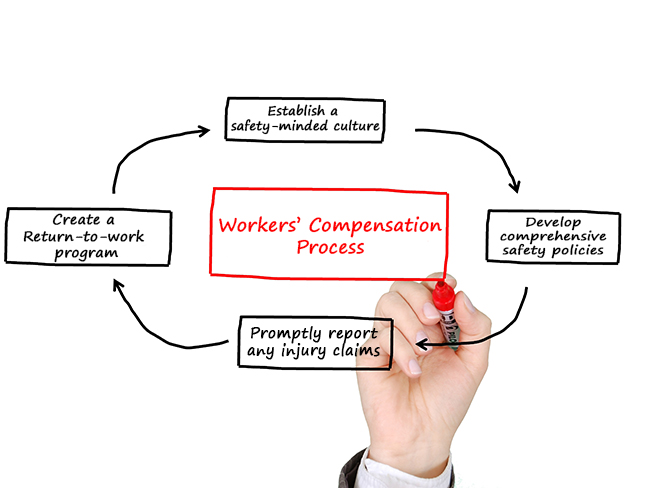
By developing a cohesive workers’ compensation process, you can play an active role in reducing related costs.
Areas requiring WC management can be divided into three main categories. These categories include facets that may range from the simple to the complex, but as a whole, address vital issues that can negatively influence WC costs in your company.
Workplace Safety Means Fewer Claims
Simply put, reducing claims reduces costs. Establishing a safety-minded culture throughout every level of your company is essential to keeping workers injury free. However, establishing such a culture isn’t an overnight solution. To be successful, an ongoing commitment to safety must be made. Such a commitment must be supported by management and given the necessary resources to succeed.
Developing comprehensive safety policies for employees builds a firm foundation for your safety culture to grow. Such policies also encourage OSHA compliance, further improving your safety efforts while helping you avoid costly fines.
Mitigate Loss After an Injury
Unfortunately, even with all the right programs in place, it is still possible for accidents to happen. When a workplace incident occurs how you respond can greatly influence the outcome of the claim. Prompt claim reporting is essential to keeping costs down.
It is also important to have a designated injury management coordinator, someone who can supervise open claims and work with both employees and medical personnel to facilitate the timely recovery.
The longer an employee is out of work the more expensive their claim will be. Return-to-work programs that allow injured employees to come back to work at a limited capacity during the recovery process, are one of the most effective tools business owners have to reduce the severity of a claim.
Managing Your Mod
Insurers use what is known as an experience modification factor, or mod, to calculate the premiums you pay for workers’ compensation coverage. By managing your exposures and promoting safety it is possible to manage your mod and decrease your premium rates.
Like a good safety program, controlling your mod is an ongoing process. To reap the benefits of lower premiums you will have to keep in regular contact with your insurance provider to ensure they have the most accurate data to use in their calculations.
Read more
