 Demographic changes in today’s workplace are impacting the way risk managers handle lost Productivity, the cost of wage replacement, and skyrocketing workers comp premiums that are created by the health problems their employees face. Chronic medical conditions such as heart disease, arthritis, back problems, respiratory disease, and diabetes are far more prevalent among workers aged 55 and above. These workers account for an ever-greater share of the labor force, than among younger employees.
Employers who promote healthy life style choices offer an effective way to reduce health related costs. Experts recommend taking these steps:
- Encourage workers to educate themselves about their health problems.
- Offer health risk appraisals to employees.
- Introduce disease management programs to promote healthy behavior.
- Make healthy food options available.
- Encourage exercise.
- Discourage unhealthy habits. For example, make the workplace tobacco free.
- If you have a fairly large workforce, provide on-site medical facilities.
- Use employee assistance programs (EAPs) to help with family and home issues that often emerge when managing long term chronic conditions.
- Create mobility throughout the day. Being sedentary or standing for long periods can create problems for employee with health conditions.
- Conduct periodic ergonomic assessments.
- Encourage breaks in concentration and focus by dividing tasks into shorter cognitive units.
- Establish a safety committee that recognizes and rewards valuable safety suggestions.
- Build in accountability for the workplace health and safety committee at the supervisory level.
Of course, these guidelines apply equally to all of your employees.
To learn more, feel free to give a call.
Read more
 Businesses are transferring more and more client information files online for storage on hard drives in remote data centers or server farms that offer convenient Internet access. Buying space in this “cloud” (a $40 billion a year business, according to the IDC research firm) is becoming as common as paying for power, water and Internet service. With corporate spies after trade secrets, hackers out to steal sensitive financial information, and the federal government demanding online communications records, protecting data in the cloud creates a serious security risk for companies of all sizes.
“It’s easy to overlook security because of the virtual nature of the cloud,” warns Thomas Trappler, Director of Software Licensing at UCLA. “Your data is going over the Internet to another computer and not to some magical world where everything’s going to be fine.” Unfortunately, businesses often seem blissfully unaware of this threat: a recent nationwide study by the Ponemon Institute found that half the firms surveyed had not considered security risks when storing data with providers in the cloud.
A major question in these deals is determining who’s responsible for the risk of compromised data. Because companies often lack security expertise, they expect cloud providers to do the job. Some providers certify that they meet government or third-party standards for data confidentiality. However, few of them let clients test their digital security – which leaves their clients feeling that they might be liable.
To minimize this risk, Trappler advises businesses to:
- Evaluate the provider’s reputation.
- Insist on reviewing its encryption and security systems.
- Set guidelines for immediate notification of any breaches.
You can also protect yourself from the risks of storing data in the cloud by investing in Cyber Insurance. To learn more, just get in touch with us.
Read more
.JPG) With slips, trips and, falls remaining one of the top causes of workers compensation claims, safety experts stress the need for preventive measures and ergonomic workplace design.
With slips, trips and, falls remaining one of the top causes of workers compensation claims, safety experts stress the need for preventive measures and ergonomic workplace design.
Such accidents need particular attention in nonindustrial environments where employers often install terrazzo or marble floors that can be dangerous to walk on.
According to the U.S. Bureau of Labor Statistics, same- level slips, trips and falls (in which workers slip and fall on the surface where they’re standing) accounted for 134,580 lost workdays and 111 deaths in 2011. The number of same-level falls increased 42.3% from 1998 to 2010, the highest growth of any accident type during this period. These mishaps are costly, in 2010, Liberty Mutual a a leading workers comp insurance company, paid $8.61 billion in same-level fall comp claims.
Implementing safety measures such as, cleaning spilled liquids promptly and placing floor mats on smooth flooring will help prevent workplace injury. Reviewing injury records to find trends will help determine additional safety measures to implement in the workplace. Many businesses are replacing surfaces that contribute to these mishaps which is a highly cost effective investment that can curb expensive litigation and workers comp liabilities.
Although these precautions have prevented thousands of slip-and-fall accidents, the risk will remain a problem until employers work with design professionals to create ergonomically friendly safe buildings. The National Institute of Occupational Safety and Health (NIOSH) is sponsoring a “Prevention Through Design” initiative to address ways that architects and engineers can get involved in designing safer workplaces (for example, by training college engineering and architecture students about safety and ergonomic considerations).
Our workers comp specialists would be happy to check your business for slip and fall hazards and recommend steps to help keep your staff and visitors from slipping.
Read more
 If your employees slip up in using personal protective equipment, the results can be dangerous, if not deadly.
Among many health and safety professionals, PPE comes in last place—behind engineering controls and work practice or administrative controls – because it only addresses hazards indirectly and has the most potential failure points.
One of these potential points involves interaction between the worker and equipment, when employees make critical mistakes in the care, use, and replacement of PPE.
- Mistake No. 1: Improper care. For example, a worker takes her foam earplugs out to consult with another worker about a problem, and then rolls the earplugs again with dirty hands before reinserting them. At the end of the day, she leaves the earplugs inside her hard hat and re-uses them the next workday.
- Mistake No. 2: Misuse. A worker wearing a fall protection harness leaves the harness loose, but pulls the lanyard tight. Another worker who uses a respirator at work decides to grow a beard.
- Mistake Number 3: Failure to replace PPE as needed. Let’s say that a supervisor whose workers are supposed to use a new pair of chemical protective gloves each day, decides he will save his department money by telling workers to use each pair of gloves for a week before replacing them. After all, they still look fine after a week. Equipment should be changed 1) after each shift, it it’s disposable (gloves protective clothing, etc.). 2) whenever it shows signs of wear and tear or damage. 3) on schedule, if it’s reusable and must be replaced before exceeding its useful life. and 4) after a save, for single-use PPE, such as hardhats, fall protection harnesses and lanyards.
A word to the wise …
Read more
 Workplace safety signs and tags play a key role in helping prevent accidents to workers and visitors alike.
To make the most effective use of signs and tags in your facility that comply with OSHA regulation (29 CFR 1910.145), we’d recommend that you follow these guidelines:
- Identify all hazards throughout the workplace. In addition to obvious dangers, include those that are out of the ordinary, unexpected, or not readily apparent.
- Select or design signs and tags. Make sure they conform to OSHA requirements and are consistent in format.
- Use proper wording. According to OSHA, “the wording of any sign should be easily read, concise, and contain sufficient information to be easily understood.”
- Position signs carefully. Signs should be placed so that they’re easy to see and read from a distance and draw maximum attention to hazards.
- Identify safety and fire protection equipment clearly. This includes such items as eyewash stations and safety showers, as well as fire extinguishers and hoses.
- Employ tags properly. OSHA requires that “tags shall be used as a means to prevent accidental injury or illness to employees who are exposed to hazardous or potentially hazardous conditions, equipment, or operations.”
- Review your program whenever new hazards are introduced. If you just put up signs and tags and forget about them, your facility probably won’t be in compliance with the OSHA regulations. Check the program frequently to make sure that it’s still doing the job.
The workplace safety professionals at our agency would be happy to help you review your signage and tag policy. Give us a call at any time.
Read more
In managing today’s disability laws attorneys advise you to not fight whether something is in fact a disability, but simply to worry about whether you can reasonably accommodate limitations to meet productivity standards. A variety of accommodations might be available, depending on the circumstances. Here’s a list of possibilities. To learn more we encourage you to visit the Job Accommodation Network www.askjan.org
- 1.
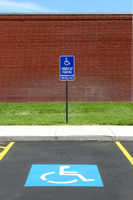 Make existing facilities accessible. This might include access to break rooms, restrooms, training rooms, parking, furniture, equipment, etc.
- Allow applicants or employees to bring assistive animals to work (of course under limited circumstances.)
- Transfer employees to a more accessible worksite.
- Transfer employees to a different job that they can, in fact, do. Note that you are not required to create a new job as an accommodation.
- Provide assistive aids and services such as qualified readers or interpreters to an applicant or employee.
- Restructure the job by the reallocating or redistributing nonessential job functions in a job with multiple responsibilities.
- Provide a part-time or modified work schedule (not as a permanent solution, but only as an accommodation.)
- Permit an alteration of when or how an essential function is performed (i.e. instead of being required to come to work at 9 they can come to work at 10).
- Provide an adjustment to modifications of exams training materials or policies.
- Allow an employee to work for from home (yes disabled employees may have a greater right to do so than your nondisabled ones).
- Provide a paid or unpaid leave (no law requires you to offer an indefinite leave.)
Of course, by now you’ve been drilled to understand that what’s a reasonable accommodation versus an undue burden varies on a case-by-case basis. You’ll need to consider the cost and nature of the accommodation, and the overall financial resources of the company, the type of operations, geographic location and other factors. Take a look at the ADA forms and the checklists in HR That Works.
Read more
