
A Health Savings Account (HSA) is an alternative to traditional Life Insurance that offers consumers a different way to pay for their health care. HSAs enable you to pay for current and future health expenses on a tax-free basis, while an attached high-deductible insurance policy protects you against catastrophic expenses.
Here are answers to some common questions concerning HSAs:
Can anyone open an HSA?
To be eligible for an HSA, you must be under 65 years old, and covered by a Qualified High-Deductible Health Policy (QHDHP).You are ineligible if covered by another Health insurance policy (except coverages such as Cancer, Dental, Disability, Long-Term Care or Vision insurance) that isn’t a qualified high-deductible plan.
Where can I open an HSA?
Accounts can be established with banks, credit unions, insurance companies, and other approved companies. Your employer might also set up a plan for its employees as well.
(…continued from previous page)
What is a QHDHP?
To qualify the policy must meet current IRS requirements. For 2009 the requirements are as follows:
- The deductible must be at least $1,150 for individuals or $2,300 for families.
- The annual out-of-pocket expenses cannot be greater than $5,800 for an individual or $11,600 for a family. These figures include the deductible and any co-insurance, but not the premiums.
How much can I contribute to an HSA? What happens to unused funds at the end of the year?
Limits are updated annually by the IRS. For 2009, the contribution limits are $3,000 for singles and $5,950 for families. However, if you are 55 or older, you can contribute an extra $1,000.
The unused balance in an HSA rolls over automatically year after year. You won’t lose your money if you don’t spend it within the year.
How do I receive the tax benefits?
If you have an HSA through your employer, you might be able to make pre-tax payroll contributions. Otherwise, your contributions will be deductible when you file your taxes, even if you don’t itemize. Also, you are eligible to make a full contribution regardless of income unlike IRAs.
Read more

This simple but powerful technique identifies hazards before they occur, focusing on the relationships among the worker, task, tools and equipment, and the work environment. Once you’ve identified job hazards, you can eliminate or reduce them to an acceptable risk level.
This is a relatively easy task, although it takes time to analyze Risk Management hazards for each job category and each step in the job. You also have to do some digging into past performance.
Priority should go to jobs with the highest injury or illness rates; the potential to cause severe or disabling injuries or illness through simple human error, complex enough to require written instructions; or that have undergone changes in processes and procedures.
Risk Management hazard analysis involves these steps:
- Involve employees. Their unique understanding of the job can be invaluable for finding hazards. Involving employees will help minimize oversights, ensure quality analysis, and get workers to buy in to the solutions because they’ll share ownership in their safety and health program.
- Review accident history. This includes the workplace record of accidents and occupational illnesses, accident damage that required repair or replacement, and any near misses. These are indicators that existing hazard controls might be inadequate and need more scrutiny.
- Conduct a preliminary job review. Discuss with employees the hazards they know exist in their work and surroundings. Brainstorm with them for ideas to eliminate or control these perils.
- List, rank, and set priorities. List jobs with hazards that present unacceptable risks, based on those most likely to occur and with the most severe consequences. Make these jobs your first priority for analysis.
- Outline steps or tasks. Nearly every job can be broken down into job tasks or steps. When beginning a job hazard analysis, watch the employee perform the job and list each step (it might help to photograph or video the worker performing the job – these visual records can provide handy references when doing a more detailed analysis of the work). Record enough information to describe each job action without getting bogged down in details. Avoid making the breakdown so detailed that it becomes unnecessarily long or so broad that it fails to include basic steps. Review the job steps with the employee to make sure you haven’t omitted anything. Stress that you’re evaluating the job itself, not the employee’s job performance.
- Identify hazards. List the hazards you identified in Step 3 (as well as any additional hazards you discovered when observing the employee) with each step or task involved in the job.
Read more

Every employer should be prepared to conduct their own on the spot workplace injury investigation. In cases of serious injury, or injuries of a questionable nature, early intervention by the employer is essential. By being proactive, an employer can more readily reduce their liability to exposure by preventing a situation from spiraling out of control rather than engaging in a costly court action.
The main reasons to investigate are:
- This is your only opportunity to conduct your own discovery into the cause or legitimacy of the injury while the incident is fresh.
- Allows you to obtain the witness versions of the incident before details are forgotten, in some instances to prevent possible deception or collusion.
- Provides the best opportunity to understand the underlying cause of the incident and to make an informed management decision.
Understanding How to Conduct an Investigation
Every investigation is really nothing more than a step-by-step logical process. You are best served to have specific individuals designated to perform the investigation.
Your purpose as an investigator will be to determine whether the alleged workplace injury had a casual connection with the worker’s employment. You want to know whether the worker was exposed to a particular danger or possibly some other risk peculiar to the Worker’s Compensation actions at the time of the alleged injury.
Read more

Foreclosure
You’ve probably seen former Tonight Show host Ed McMahon in the headlines lately. In a sad turn of events, McMahon, once famous for knocking on people’s door to make their dreams come true, is now facing the nightmare of losing his home to foreclosure.
Records show McMahon is $664,000 behind in payments on his Beverly Hills mansion. How could this happen? Simple: McMahon got caught by the housing bust just like so many other Americans.
These days it is so important to have a Insurance company with your best interest in mind. Personal Insurance mistakes are common for the simple fact people aren’t doing their homework on multi policy discounts.
Call Scurich Insurance today to find out how we can help you save BIG!
Tony Scurich
Scurich Insurance Services
A Member of United Valley Insurance Services
P.O. Box 1170
Watsonville, Ca 95077-1170
Ph# 831-722-3541 Ext. 15
Fax# 831-722-1997
Email: [email protected]
Read more
 Although Workers Comp policies go by the official name of “Workers Compensation and Employers Liability,” it’s easy to overlook the “Employers Liability’ coverage, which protects your business against liability arising from physical injury and occupational illness claims that Workers Comp doesn’t cover. The Employers Liability section resembles a Commercial General Liability (CGL) policy, defending the employer against claims and paying the employee, dependents, or others in cases of employer negligence.
Consider these types of claims:
- Action-Over: Let’s assume that Curbside Concrete’s employee is injured in an accident while driving a company mixer and sues the other driver, who then sues Curbside, arguing that a defect in its truck caused the accident. Employees who use tools are especially prone to filing claims of this type: the employee sues the manufacturer of a tool that injured them on the job. The manufacturer then counter-sues the employer for negligence in failing to supervise the employees on the safe use of its tool.
- Loss of Consortium: A seriously injured or dead employee might have a relative or spouse who sues the firm for the resulting loss of normal relations with the disabled or deceased companion. This absence can affect a son or daughter with a mother or father who can no longer fulfill the proper role of a parent, as well as someone whose spouse’s sexual function has diminished.
- Consequential Bodily Injury: A worker’s injury has an adverse on one of their relatives. For example, after Joe suffers an injury on the job, his sister must now quit her job to drive him to the occupational therapist every day.
- Dual Capacity: A firm faces a suit beyond its role as the injured worker’s employer. Mike, the building maintenance worker, is injured while installing a basketball hoop in the company gym by a drill manufactured by his employer, Dynamic Drill, Inc. He files a suit against Dynamic as creator of the tool, not as the employer. A dual capacity claim allows Mike to circumvent the prohibition under Workers Compensation law against suing his employer.
These workplace occurrences are not far-fetched. Our Risk Management professionals would be happy to provide a thorough review of your Workers Comp policy to make sure that you have the protection you need.
Read more
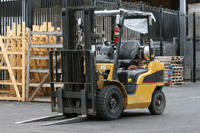
This real-life case reinforces the need for every business to provide OSHA-required training, along with providing some type of Safety Services training.
A West Virginia company assigned a new employee – call him Jim – to drive a forklift, even though he had no experience or training in forklift operation “There’s nothing to it,” his supervisor told Jim. “It’s just like driving a car.” However, his first few weeks on the job turned out to be bumpy. Several times on each shift, while driving the forklift, he would knock things over. Although the supervisor warned Jim to be more careful, he continued to bump his way through the workday, leaving a trail of destruction wherever he went.
About three weeks after being hired, Jim’s supervisor instructed him to drive down a narrow aisle between two rows of stacked, loaded pallets. After objecting, Jim reluctantly proceeded down the aisle. His left foot, which was dangling outside the forklift where it shouldn’t have been, became pinned between the forklift and the wall of pallets. Jim suffered multiple fractures of the foot, together with a badly twisted knee; both injuries required surgery. Instead of going back to work, Jim went to court, filing suit against his employer and his supervisor for negligence.
His argument was clear: The company and his supervisor failed to provide safety training that could have prevented the accident. Jim’s attorney told the court that, although OSHA regulations mandated specific training, testing, and certification for forklift operators, the company had not trained, tested, or certified him. This meant that Jim should not have been operating a forklift – and if he hadn’t been doing so, the accident would not have taken place.
The Supreme Court of Appeals of West Virginia agreed, ruling there was sufficient evidence to prove that both the employer and the supervisor were negligent. When they hired the employee; they knew that federal law required proper training or certification of forklift operators. Allowing Jim to drive a forklift without proper training was an act of negligence.
The message: Failure to provide OSHA-required training is a huge mistake. Whenever you hire new employees or assign workers to new jobs with new hazards, make sure that they receive proper training from the get-go. Never allow an employee to operate dangerous equipment or perform any other hazardous job until they have completed the required training and demonstrated competence, as well as understanding the hazards and necessary precautions. Lastly, provide workers with some type of training in Safety Services, every bit of knowledge helps!
Read more
