 In the April 2013 issue of Corporate Counsel an article entitled It’s a Systemic World Out Therediscusses the EEOC’s pursuing large “systemic” cases. For example, in fiscal year 2011 they conducted 580 systemic investigations, filed 84 systemic lawsuits, and settled 35 systemic cases for total $9.6 million. Although your company might not be large enough to be on the EEOC’s radar screen, I can tell you that attorneys are also suing small to midsized companies on a class basis. An employee walks into a lawyer’s office because they didn’t receive their final paycheck, and before you know it they’re filing a class-action lawsuit against your company for missed overtime and meal periods. The article provided a few golden nuggets of advice:
- When responding to an EEOC inquiry, don’t use the phrase “pursuant to our consistently applied policy.” This only invites a broader request for information.
- Do not submit more information than is necessary.
- Conduct your own statistical analysis before submitting data.
- Do preventative analysis looking for adverse impacts in the hiring, promotion, or termination practices.
- Validate pre-employment tests.
- Conduct preventative compensation analysis periodically.
- Cover all internal analysis with attorney-client privilege. This might be impossible in smaller organizations, but you can certainly retain outside counsel to instruct you on how to conduct such analysis and report back to them.
- Listen to your employees. As I have always recommended, you should survey your employees, including use of the Employee Compliance Survey that can be found in HR That Works.
- Invigorate that underutilized internal complaint system. Again, go one step further and ask if there’s a problem –don’t wait for them to tell you there is one.
- Stay current with legal trends. This is one reason why HR That Works membership is so valuable.
- Walk the talk. Are you sensitive to the potential for your practices to cause adverse impacts? Frankly in my experience I can tell you that some business owners could care less about whether a practice causes an adverse impact. All they care about is getting the best employees they can, damn the EEOC. Of course, few companies appreciate a risk until they’re hit with it.
Finally, the article points out how large corporations can gather the data requested by the EEOC easily because they have such large HRIS systems. However, most companies with less than 500 employees don’t have this data readily available, and t collecting it can be an over-burdensome process. This is one reason to make sure that you hire an attorney any time you receive a communication from the EEOC or another regulatory agency.
Read more
 The financial well-being of your employees affects their health, their productivity and your bottom line!
A recent nationwide survey by Purchasing Power, Inc. found that:
- A high percentage of employees suffer significant financial stress. More than one in four workers surveyed (28%) find it hard to meet monthly household expenses and nearly half (44%) have less than $2,000 in emergency savings.
- They bring these concerns to the job. More than four in ten (44%) worry about personal finances during work hours.
- This stress leaves them less engaged at work and reduces productivity. Nearly three in ten employees (29%) deal with personal finances during work hours and almost half of these (46%) average two to three hours a week on money issues.
Purchasing Power Chief Revenue Officer Elizabeth Halkos offers some recommendations to help your workers maintain their engagement and productivity at the office:
- Help them reduce debt by offering education, either in groups (through webinars or with a live speaker) or individually so that workers can learn about topics such as budgeting, intelligent use of credit and savings programs. A referral to a qualified credit counseling agency can provide a useful follow-up.
- Give them access to responsible budgeting tools. Offering non-traditional voluntary benefits, such as employee purchase programs ( which allow workers to acquire high-ticket items and educational services on a “forced saving” basis through payroll deduction) can help reduce their financial stress significantly.
- Encourage employees to participate in retirement programs such as a 401(k) plan. However, before workers do this, advise them to deal with debt and budgeting issues and tuck away a nest egg.
Our Benefits experts stand ready to help you ensure financial peace of mind for your workers. Just give us a call.
Read more
.JPG) With slips, trips and, falls remaining one of the top causes of workers compensation claims, safety experts stress the need for preventive measures and ergonomic workplace design.
With slips, trips and, falls remaining one of the top causes of workers compensation claims, safety experts stress the need for preventive measures and ergonomic workplace design.
Such accidents need particular attention in nonindustrial environments where employers often install terrazzo or marble floors that can be dangerous to walk on.
According to the U.S. Bureau of Labor Statistics, same- level slips, trips and falls (in which workers slip and fall on the surface where they’re standing) accounted for 134,580 lost workdays and 111 deaths in 2011. The number of same-level falls increased 42.3% from 1998 to 2010, the highest growth of any accident type during this period. These mishaps are costly, in 2010, Liberty Mutual a a leading workers comp insurance company, paid $8.61 billion in same-level fall comp claims.
Implementing safety measures such as, cleaning spilled liquids promptly and placing floor mats on smooth flooring will help prevent workplace injury. Reviewing injury records to find trends will help determine additional safety measures to implement in the workplace. Many businesses are replacing surfaces that contribute to these mishaps which is a highly cost effective investment that can curb expensive litigation and workers comp liabilities.
Although these precautions have prevented thousands of slip-and-fall accidents, the risk will remain a problem until employers work with design professionals to create ergonomically friendly safe buildings. The National Institute of Occupational Safety and Health (NIOSH) is sponsoring a “Prevention Through Design” initiative to address ways that architects and engineers can get involved in designing safer workplaces (for example, by training college engineering and architecture students about safety and ergonomic considerations).
Our workers comp specialists would be happy to check your business for slip and fall hazards and recommend steps to help keep your staff and visitors from slipping.
Read more
 If your employees slip up in using personal protective equipment, the results can be dangerous, if not deadly.
Among many health and safety professionals, PPE comes in last place—behind engineering controls and work practice or administrative controls – because it only addresses hazards indirectly and has the most potential failure points.
One of these potential points involves interaction between the worker and equipment, when employees make critical mistakes in the care, use, and replacement of PPE.
- Mistake No. 1: Improper care. For example, a worker takes her foam earplugs out to consult with another worker about a problem, and then rolls the earplugs again with dirty hands before reinserting them. At the end of the day, she leaves the earplugs inside her hard hat and re-uses them the next workday.
- Mistake No. 2: Misuse. A worker wearing a fall protection harness leaves the harness loose, but pulls the lanyard tight. Another worker who uses a respirator at work decides to grow a beard.
- Mistake Number 3: Failure to replace PPE as needed. Let’s say that a supervisor whose workers are supposed to use a new pair of chemical protective gloves each day, decides he will save his department money by telling workers to use each pair of gloves for a week before replacing them. After all, they still look fine after a week. Equipment should be changed 1) after each shift, it it’s disposable (gloves protective clothing, etc.). 2) whenever it shows signs of wear and tear or damage. 3) on schedule, if it’s reusable and must be replaced before exceeding its useful life. and 4) after a save, for single-use PPE, such as hardhats, fall protection harnesses and lanyards.
A word to the wise …
Read more
 Workplace safety signs and tags play a key role in helping prevent accidents to workers and visitors alike.
To make the most effective use of signs and tags in your facility that comply with OSHA regulation (29 CFR 1910.145), we’d recommend that you follow these guidelines:
- Identify all hazards throughout the workplace. In addition to obvious dangers, include those that are out of the ordinary, unexpected, or not readily apparent.
- Select or design signs and tags. Make sure they conform to OSHA requirements and are consistent in format.
- Use proper wording. According to OSHA, “the wording of any sign should be easily read, concise, and contain sufficient information to be easily understood.”
- Position signs carefully. Signs should be placed so that they’re easy to see and read from a distance and draw maximum attention to hazards.
- Identify safety and fire protection equipment clearly. This includes such items as eyewash stations and safety showers, as well as fire extinguishers and hoses.
- Employ tags properly. OSHA requires that “tags shall be used as a means to prevent accidental injury or illness to employees who are exposed to hazardous or potentially hazardous conditions, equipment, or operations.”
- Review your program whenever new hazards are introduced. If you just put up signs and tags and forget about them, your facility probably won’t be in compliance with the OSHA regulations. Check the program frequently to make sure that it’s still doing the job.
The workplace safety professionals at our agency would be happy to help you review your signage and tag policy. Give us a call at any time.
Read more
In managing today’s disability laws attorneys advise you to not fight whether something is in fact a disability, but simply to worry about whether you can reasonably accommodate limitations to meet productivity standards. A variety of accommodations might be available, depending on the circumstances. Here’s a list of possibilities. To learn more we encourage you to visit the Job Accommodation Network www.askjan.org
- 1.
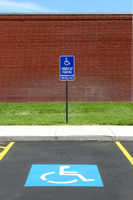 Make existing facilities accessible. This might include access to break rooms, restrooms, training rooms, parking, furniture, equipment, etc.
- Allow applicants or employees to bring assistive animals to work (of course under limited circumstances.)
- Transfer employees to a more accessible worksite.
- Transfer employees to a different job that they can, in fact, do. Note that you are not required to create a new job as an accommodation.
- Provide assistive aids and services such as qualified readers or interpreters to an applicant or employee.
- Restructure the job by the reallocating or redistributing nonessential job functions in a job with multiple responsibilities.
- Provide a part-time or modified work schedule (not as a permanent solution, but only as an accommodation.)
- Permit an alteration of when or how an essential function is performed (i.e. instead of being required to come to work at 9 they can come to work at 10).
- Provide an adjustment to modifications of exams training materials or policies.
- Allow an employee to work for from home (yes disabled employees may have a greater right to do so than your nondisabled ones).
- Provide a paid or unpaid leave (no law requires you to offer an indefinite leave.)
Of course, by now you’ve been drilled to understand that what’s a reasonable accommodation versus an undue burden varies on a case-by-case basis. You’ll need to consider the cost and nature of the accommodation, and the overall financial resources of the company, the type of operations, geographic location and other factors. Take a look at the ADA forms and the checklists in HR That Works.
Read more
