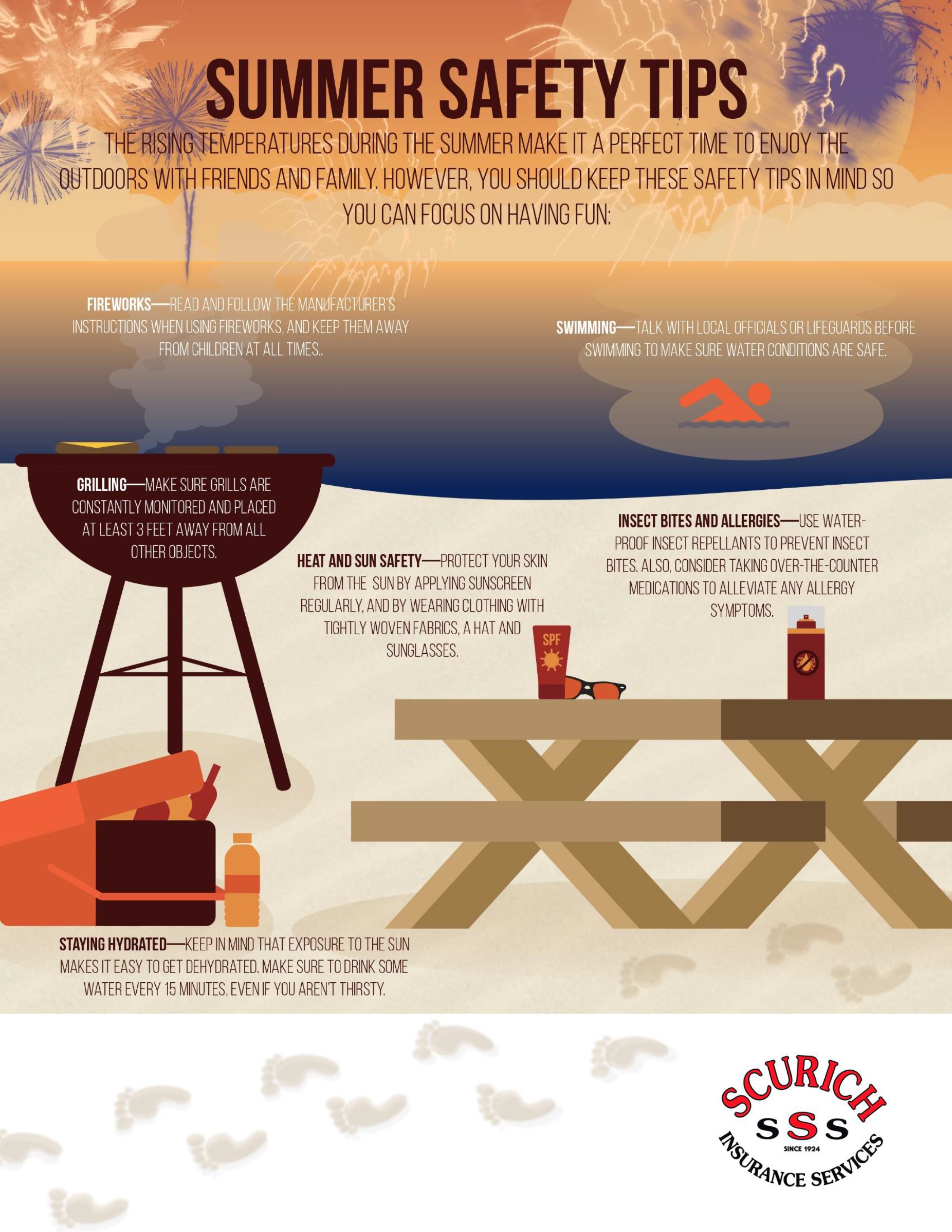
The rising temperatures during the summer make it a perfect time to enjoy the outdoors with friends and family. However, you should keep these safety tips in mind so you can focus on having fun.
Fireworks
Read and follow the manufacturers instructions when using fireworks, and keep them away from children at all times.
Swimming
Talk with local officials or lifeguards before swimming to make sure water conditions are safe.
Grilling
Make sure grills are constantly monitored and placed at least 3 feet away from all other objects.
Heat and Sun Safety
Protect your skin from the sun by applying sunscreen regularly, and by wearing clothing with tightly woven fabrics, a hat and sunglasses.
Insect Bits and Allergies
Use water-proof insect rellants to prevent insect bits. Also, consider taking over-the-counter medications to alleviate any allergy symptoms.
Staying Hydrated
Keep in mind that exposure to the sun makes it easy to get dehydrated. Make sure to drink some water every 15 min, even if you aren’t thirsty.
Read more

Employee Drug Use Reaches 12-year High
The positive drug test rate for the U.S. workforce was 4.2 percent in 2016, according to the Drug Testing Index (DTI) released by Quest Diagnostics. This represents a 5 percent increase over the positive rate in 2015, and the largest single-year positive rate since 2004.
The DTI analyzed over 10 million workforce drug test results from 2016 and categorized employees into three categories, including employees with federally mandated drug tests, the general workforce and the combined U.S. workforce. Here are additional details about the DTI’s findings for specific drug types:
- Marijuana—The positive test rate for marijuana increased nearly 75 percent in oral fluid testing, which is used in the general workforce. Federally mandated marijuana tests only utilize urine tests, and the positive test rate increased 10 percent in 2016.
- Cocaine—Positive test rates for cocaine in post-accident drug tests were more than twice as high as pre-employment screenings.
- Amphetamines—Positive test rates for amphetamines have risen 64 percent between 2012 and 2016 for the general workforce. Quest Diagnostics attributes this increase to the prevalence of prescription drugs, including Adderall.
In order to create a safe, productive workplace, you need to watch out for potential drug use at your business.
Political Discussions Hurt Job Performance
Many people can get worked up about politics, but a new survey from the American Psychological Association (APA) has shown that political discussions in the workplace can have a big impact on your employees’ job performance.
The APA surveyed U.S. employees about the impact of political discussions after the 2016 presidential election, and found that these discussions have a detrimental effect on job performance and relationships with co-workers. The survey found that 40 percent of employees have experienced a negative outcome following a workplace political discussion, such as reduced productivity or difficulty getting work done. Additionally, 24 percent of employees said they avoid some co-workers solely because of their politics.
According to the APA, social networks and constant news reports can cause individuals to adopt an “us versus them” political mentality, which can lead to conflict. As a result, it’s important to encourage respect, collaboration and courtesy in your workplace to ensure that your employees feel supported and remain productive.
New Executive Order Aims to Improve Cyber Security
President Donald Trump recently signed an executive order to improve the country’s cyber security and protect key infrastructure from cyber attacks. The order also emphasized the importance of strengthening the cyber security of federal agencies. According to a survey from Thales Group, a cyber security company, 34 percent of federal agencies experienced a data breach in the last year, and 95 percent of agencies consider themselves vulnerable to cyber attacks.
The executive order did not create any ongoing cyber security requirements, but instead laid out goals to assess the current state of cyber defenses and develop deterrence strategies. Here are some of the requirements of the executive order:
- Federal agencies must draft reports on their ability to defend themselves against cyber threats.
- The departments of Energy and Homeland Security must assess potential vulnerabilities to the country’s electrical grids. The executive order specifically mentions that prolonged power outages could pose a threat to national security or damage the economy.
- Various federal agencies must review the cyber defense plans of U.S. allies in order to cooperate during international cyber attacks.
Apple Creates $1 Billion Fund to Support U.S. Manufacturing
Apple, the world’s largest technology company, recently announced that it will create a $1 billion fund to support U.S. manufacturing. Although the company is based in the United States, it has faced criticism for outsourcing most of its manufacturing and taking jobs from U.S. workers.
Apple’s CEO stated that one goal of the fund was to support smart manufacturing and to create a ripple effect in industries that support smart manufacturers. For more information on the manufacturing fund, visit Apple’s website.
DID YOU KNOW?
A U.S. Court of Appeals recently barred the Federal Aviation Administration (FAA) from requiring recreational drone owners to register their unmanned aircraft. The FAA had originally required recreational drones to be registered in order to help identify aircraft that posed a hazard, and to pass on safety information to operators. However, the court’s ruling will not impact the use of drones for commercial use, as these aircraft must still be registered with the FAA before they are used.
Read more

On May 15, 2017, the Centers for Medicare and Medicaid Services (CMS) announced significant changes to the Small Business Health Options Program (SHOP) Exchanges under the Affordable Care Act (ACA). Under these changes:
- Employers would be able to obtain an eligibility determination for SHOP participation through www.HealthCare.gov.
- Employers would enroll directly with an insurance company offering SHOP plans, or with the assistance of an agent or broker registered with the Exchange, instead of enrolling online at www.HealthCare.gov.
CMS plans to issue regulations implementing these changes, effective Jan. 1, 2018.
ACTION STEPS
These changes apply in federally facilitated SHOPs (FF-SHOPs) and state-based SHOPs using the federal platform. State-based SHOPs could continue to provide online enrollment or adopt the federal direct enrollment approach.
SHOP Exchanges
The ACA required each state to establish an online competitive marketplace, called an Exchange, where individuals and small businesses may purchase health insurance, beginning in 2014. The SHOP is the Exchange component for small businesses.
Online enrollment in FF-SHOPs was previously delayed until Nov. 15, 2014, as a result of problems with implementation. Prior to Nov. 15, 2014, employers had been required to use a direct enrollment process, using an agent, broker or insurer to enroll their employees in FF-SHOP coverage for 2014 (similar to how most small employers previously got insurance).
Many state-based SHOP Exchanges chose to offer online enrollment earlier than the FF-SHOP, in 2014.
Ending Online Enrollment in FF-SHOPs
The changes announced by CMS will effectively end online enrollment in FF-SHOPs. Under the intended approach, however, employers would still obtain a determination of eligibility for SHOP participation by going to www.HealthCare.gov, which allows eligible employers to access the Small Business Health Care Tax Credit.
According to CMS, these changes are being made to promote insurance company and agent/broker participation and make it easier for small employers to offer SHOP plans to their employees, while maintaining access to the Small Business Health Care Tax Credit. CMS noted that insurance company and agent/broker participation, as well as overall enrollment in the FF-SHOP Exchanges, has been lower than anticipated and, at its current pace, is unlikely to reach expectations.
Impact for Employers Currently Using the SHOP Exchange
Employers can sign up for SHOP coverage taking effect in 2017 on www.HealthCare.gov until Nov. 15, 2017. In addition, employers that have enrolled in SHOP coverage for the 2017 plan year would be able to continue using www.HealthCare.gov in 2018 for enrollment and premium payment, until their current plan year ends and it’s time to renew.
States operating state-based SHOPs would be able to provide online enrollment, or could opt to direct small employers to insurance companies and SHOP-registered agents and brokers to directly enroll in SHOP plans.
IMPORTANT DATES
January 1, 2018
CMS plans to issue regulations ending online enrollment in FF-SHOPs, effective in 2018.
November 15, 2017
Employers can sign up online for SHOP coverage taking effect in 2017 until Nov. 15, 2017.
Read more

Just a few years ago, taking a trip involved contacting travel agencies, booking hotel rooms and making plans far in advance. Today, however, smartphones and the internet have helped create new sharing services that allow homeowners to connect with travelers and rent out their homes, spare bedrooms or other accommodations for a fee.
Airbnb, the most popular of these sharing services, offers a convenient platform that can provide homeowners with an extra source of income. However, renting through Airbnb can also expose you to substantial risks and leave you with costly property damage and liability claims.
Potential Insurance Gaps
Relying strictly on your regular homeowners or renters insurance policy while hosting guests through Airbnb can lead to significant gaps in coverage. These policies are designed to protect you and your family from everyday risks, and not from commercial renting.
If a renter uses your home for even a small amount of time, you and your family will be exposed to significantly different risks that weren’t considered when your policy was drafted. As a result, most homeowners and renters policies won’t cover property damage that’s caused by Airbnb guests.
If you’re considering renting through Airbnb, your first step should be to contact your insurance broker to review your current homeowners or renters insurance policy. While your homeowners or renters policy may allow you to rent your property to a guest, it’s important to keep in mind that each insurer has its own restrictions and requirements. Some insurers may require advanced notice of any short-term rental, whereas others might insist that you purchase an endorsement to expand your coverage.
If you plan to rent out your residence on a regular basis, many insurance companies will consider this commercial use. In many cases, regular Airbnb hosts will need to obtain a commercial insurance policy in order to be properly insured. However, a growing number of insurance companies now offer home-sharing liability insurance policies that can be purchased on a month-to-month basis.
Issues with Airbnb’s Provided Protection
Airbnb does offer its hosts two forms of protection through its host guarantee program and host protection insurance. While hosts may be inclined to rely exclusively on these programs to manage their risks, there are significant gaps related to these offerings.
Host Guarantee
Airbnb backs every one of its bookings with its host guarantee program at no cost, which will reimburse eligible hosts for damages up to $1 million. However, Airbnb readily admits that its host guarantee is not insurance and should not be considered a replacement or stand-in for homeowners or renters policies.
Moreover, payments through the host guarantee are subject to a lengthy list of terms, conditions and exclusions. Therefore, hosts should be aware of the following issues related to Airbnb’s host guarantee:
- Hosts must attempt to resolve any issues with the guests involved prior to receiving any compensation. This also means that a host would have to make a claim on his or her own insurance policy before the host guarantee would apply.
- Any sum collected from a standard policy or a security deposit would be deducted from the host guarantee.
- The guarantee will only repair or replace covered property that is damaged during the time frame of an online booking.
- This guarantee does not cover certain items including, but not limited to, cash, collectibles, jewelry, pets, watercrafts or any damage to property that is not considered a covered accommodation.
For more information on specific elements of Airbnb’s host guarantee program, hosts can review its terms and conditions in full on the company’s website.
Host Protection Insurance
In addition to its host guarantee program, Airbnb offers coverage to its patrons through its host protection insurance. Airbnb indicates that the program provides primary liability coverage for up to $1 million per occurrence in the event of third-party claims of bodily injury or property damage. Despite these claims, hosts should be wary of relying solely on this insurance program for a number of reasons:
- Intentional acts that aren’t the result of an accident are not covered under this policy. In addition, Airbnb’s home protection insurance does not cover what it refers to as property issues, which can include things like mold, asbestos and bedbugs.
- Neither Airbnb’s home protection insurance nor its fine print is readily available for review. The policy is also subject to limitations, conditions and exclusions. Together, this means that the specifics of these coverages are vague, and Airbnb hosts may not know exactly what’s protected.
- The personal property of any guest is generally not covered. Additionally, any theft or damage caused by a guest may not be covered either.
With Airbnb’s host protection insurance, it’s best to assume that you aren’t equipped with the proper coverage. For full protection, it is likely that you will need to speak with an insurance professional to better understand the policy adjustments you will need in order to be fully covered.
Considerations for Condo Owners and Renters
While Airbnb opens its services to condo owners and renters, multi-unit buildings often have restrictive bylaws, homeowner association rules or lease terms that could impact the ability to host guests through Airbnb.
In many instances, commercial activities like renting out accommodations—even for short periods of time—are forbidden by lease or condo board policies. In some cases, hosts will need to contact their landlord or condo board before subletting or renting out any accommodations. Failure to do this can result in eviction or other forms of legal action.
Even if you’re allowed to rent out your condo or apartment through Airbnb, doing so can cause tension with neighbors. There’s always the potential that your guests may not be respectful to property in common areas, act inappropriately or noisily, or make other tenants feel uncomfortable.
Local Laws and Considerations
In response to the rising popularity of Airbnb, many states, cities and towns are moving to regulate short-term property rentals through their municipal codes or zoning regulations. In some cases, home rental services like Airbnb could be prohibited altogether.
If you break these local regulations, purposely or otherwise, you could face thousands of dollars in fines. What’s more, Airbnb says alignment with laws and regulations is the responsibility of those renting out accommodations. As a result, you need to review your local laws and regulations before using Airbnb to rent out your accommodations.
The Bottom Line
While Airbnb offers a unique and potentially profitable service to users, it’s not without its faults. Before you decide to try it for yourself, be sure to consider all of the risks. For more information on sharing services, or to review your homeowners or renters policy, contact us at 831-661-5697 today.
Read more

OVERVIEW
The Occupational Safety and Health Administration’s (OSHA) electronic reporting rule requires certain establishments to report information electronically from their OSHA Forms 300, 300A and 301. The rule also requires OSHA to create a website that can be used to submit the required information. Under the rule, the first reports are due by July 1, 2017.
However, on a recent update to its recordkeeping webpage, OSHA indicated it will not be ready to receive electronic workplace injury and illness reports by the established deadline. No new reporting deadline has been adopted yet.
ACTION STEPS
OSHA has not officially delayed the July 1, 2017, deadline, but its website will not be ready to receive electronic reports from employers by this time.
Affected establishments should continue to record and report workplace injuries as required by law and should monitor these developments to learn whether a new reporting deadline will be adopted.
HIGHLIGHTS
- The rule requires OSHA to create and provide a secure website to transmit electronic information.
- Under the rule, OSHA will publicize the information received from the electronic reports.
- The final rule has met significant opposition and its validity is currently being challenged in federal court.
IMPORTANT DATES
May 12, 2016
OSHA issues its final electronic reporting rule. The first reporting deadline is set for July 1, 2017.
May 16, 2017
OSHA indicates its reporting website will not be ready to receive the first reports by the July 1 deadline.
Read more

On May 2, 2017, the House of Representatives passed the Working Families Flexibility Act (also known as H.R. 1180). If approved, H.R. 1180 would authorize private employers to offer compensatory time instead of overtime pay for nonexempt employees who work more than 40 hours per week. H.R. 1180 still needs approval from the Senate and the executive branch before it becomes law.
Compensatory time off is already a common practice for many federal and state employers, but it is not currently allowed by the Fair Labor Standards Act (FLSA) for private employers. H.R. 1180 would amend the FLSA to allow this practice, if certain conditions are met.
ACTION STEPS
Because H.R. 1180 is not yet law, no action steps are currently required of any employers.
This Compliance Bulletin is provided for informational purposes only, to assist employers in understanding the changes H.R. 1180 would bring to current overtime compensation practices in the private sector.
Compensatory Time Off
Currently, the FLSA requires employers in the private sector to pay overtime wages to nonexempt employees for all hours of overtime worked. If approved, H.R. 1180 would amend the FLSA to allow private sector employers to provide either overtime pay or compensatory time off to nonexempt employees who work overtime hours.
H.R. 1180 is proposing that compensatory time off be calculated at the rate of 1.5 hours of compensatory time off for every hour of overtime work. As it stands, H.R. 1180 would expire within five years of its enactment. In addition, the bill would limit the amount of compensatory time off eligible employees may receive to 160 hours.
H.R. 1180 would only apply to private sector employers, meaning that if it were to be adopted, it would not affect current compensatory time off requirements for public sector employees.
Voluntary Agreement and Usage
Under H.R. 1180, both employers and employees would have to agree to compensatory time off instead of overtime wages. In unionized environments, compensatory time off would have to be allowed by any applicable collective bargaining agreement. The agreement would need to be preserved in writing and take place before any compensatory time off begins to accrue.
Finally, the language of H.R. 1180 would prohibit employers from coercing or forcing employees to agree to receive or use compensatory time off instead of overtime wages. This means that employers would not be allowed to directly or indirectly intimidate, threaten or coerce (or attempt to intimidate, threaten or coerce) employees to agree to receive or use any accrued compensatory time off.
Eligibility
Under H.R. 1180, employees would be eligible to receive compensatory time off after 1,000 hours of continuous employment during the previous 12 months.
Payment for Unused Compensatory Time
H.R. 1180 would require employers to allow employees to use any earned compensatory time off within a reasonable period, as long as this does not unduly disrupt the employer’s operations.
However, employers would be required to provide monetary compensation to their employees for any compensatory time off that is not used by the end of the calendar year, although employers would be able to determine a different 12-month period as long as it remains consistent.
Unused compensatory time would need to be paid at a rate that would at least be equal to the employee’s regular wage rate. The employee’s regular rate would be the higher of:
- The regular wage rate at the time the overtime work was performed; or
- The regular wage rate at the time the unused compensatory time off must be paid.
Payment for unused compensatory time off would be required within a month of the end of the 12-month period.
More Information
We will continue to monitor the progress of this bill through the legislative process and update you as more information becomes available. In the meantime, contact Scurich Insurance for more information regarding the FLSA and overtime wage payment requirements.
Read more
