Former Watsonville Mayor Luis Alejo made a special appearance at the Watsonville City Council meeting Tuesday night to recognize the city’s police department for the its crime-fighting prowess. The city recorded its lowest crime rate in 30 years in 2010.
“Thanks to the Watsonville Police Department for doing a tremendous job fighting violence in our community,” Alejo said in a prepared statement released before Tuesday’s event. “…I commend the great work of the Watsonville Police Department for its superior record of law enforcement.”
Alejo highlighted some of the most significant achievements:
•The overall crime rate was down 15 percent last year.
•Youth arrests dropped 34 percent.
•Violent crime fell by 8 percent.
•Property crimes were down 17 percent.
•Homicides dropped 75 percent when compared to 2009.
Central Electric Company has been insured with Scurich Insurance Services for longer than Sharon can remember. She feels that Scurich Insurance Services has a great staff that is very professional and always has a quick response. Sharon and Central Electric Company are currently insured with commercial and personal insurance, including liability, auto, home, workers comp, and umbrella coverage.
Sharon is very satisfied with her agent Tony Scurich, and the services Scurich Insurance Services provides. Not only has she saved money on her insurance policies, but she would also recommend them to her friends and family.
Scurich Insurance Services can also help get you covered with all of your insurance needs. www.scurichinsurance.com
320 East Lake Avenue, PO Box 1170
Watsonville, CA 95077-1170
Office: 1-831-722-3541
Toll Free: 1-800-320-3666
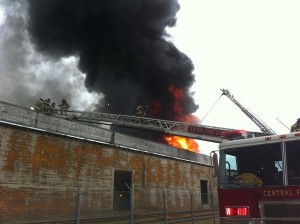
The fire sparked in a back room at Apple Growers Ice & Cold Storage Co., at 850 W. Beach St., around 3:30 p.m on Wednesday 4/20/2011. The blaze is a challenge for fire crews. The massive building, about 100 yards long and a block wide, was constructed in the 1920s using heavy timbers, solid concrete and cork—which is packed into the walls to keep the facility cool.
The flames ignited in a back room packed with Martinelli’s apple cider. In fact, most of the building was full of apple juice from the company, which has a manufacturing facility across the street. Heavy smoke billowed from the cavernous building for more than an hour as fire crews from Salinas to Scotts Valley got in place.
About two hours in, three ladder trucks lined up along the roof-line of the building. The first sprayed water onto the smoldering structure as a half-dozen firefighters used to the second truck’s ladder to get onto the roof. The roof burst into flames, shooting fire at least 20 feet into the air while black smoke billowed towards town. The firefighters retreated from the roof, repositioned the truck and used its ladder to shoot a second stream of water onto the fire. As the fire pushed through the building, the third ladder truck set up on West Beach Street to hose down the flames licking through the aging structure. At the high point, 16 fire engines, three trucks and a small legion of brass from every most every fire department in the region. The cause of the fire was unclear Wednesday night.
Scurich Insurance can help you cover your business from fire damage with Business Insurance.
320 East Lake Avenue, PO Box 1170
Watsonville, CA 95077-1170
Office: 1-831-722-3541
Toll Free: 1-800-320-3666
After risk analysis, the next step is to create a risk management plan. This plan contains the risks and details of how to deal with them. The methods to deal with different risks are based on the evaluation of the risks. This step is also called Risk Assessment. The assessment of risk is done using a numerical scale and measuring the impact of different risks. This results in a chart where each risk carries a numerical strength against the constant number. Based on the numerical strength of a risk, managers decide how to treat the risk.
A risk treatment plan explains the action plan for each identified risk. Note that it is not possible to identify all the risks associated with any project. Some risks are unexpected and need to be managed based on the immediate assessment of the risk. For identified risks, there are four methods of treatment:
•Avoidance – Avoid the risk partially or in whole
•Reduction – Employing methods to reduce the negative impacts of risks
•Sharing – Sharing/outsourcing the risk component to a third party, which is better equipped to handle such risks
•Retention – Acceptance of the risk, normally in cases where the gains from the risk component are far higher than the negative impacts of the risk

 Former Watsonville Mayor Luis Alejo made a special appearance at the Watsonville City Council meeting Tuesday night to recognize the city’s police department for the its crime-fighting prowess. The city recorded its lowest crime rate in 30 years in 2010.