
Hiring youth workers—many times to fill seasonal positions—can be an integral component to your organization’s hiring plan. Early work experience can also be a great opportunity for teenagers to learn important skills.
To promote positive and safe work experiences, the U.S. Department of Labor (DOL) has a series of regulations relating to the employment of minors. These provisions are designed to protect young workers by restricting the types of jobs that they perform and the number of hours they work. It is important to follow all federal, state and local laws regarding the employment of minors to ensure that your business remains compliant and protects its reputation.
Listed below are some age-specific workforce regulations, as presented by the DOL’s YouthRules! initiative.
Rules for Workers Under 14 Years of Age
In general, youth workers who are under the age of 14 are limited on what type of jobs they can do. Workers who are under 14 years of age are only permitted to do the following jobs:
- Deliver newspapers to customers
- Babysit on a casual basis
- Work as an actor or actress in movies, TV, radio or theater
- Work as a homeworker gathering evergreens or making evergreen wreaths
- Work for a business owned entirely by their parents as long as it is not in mining, manufacturing or any of the 17 hazardous occupations
There are different rules in place for minors in this age group who work in agriculture. States also have specific rules for youth workers under 14 years old, and employers must follow both.
Rules for Workers 14 to 15 Years of Age
Similar to workers under 14 years of age, youth workers who are 14 to 15 years old are limited on what types of jobs they can do and what hours they can work.
Job Restrictions
In general, youth workers within this age range are only permitted to do certain jobs, which include the following:
- Work an approved retail position
- Work an intellectual or creative position, such as computer programming, teaching, tutoring, singing, acting or playing an instrument
- Run errands or complete delivery work by foot, bicycle and public transportation
- Complete cleanup and yard work that does not include using power-driven mowers, cutters, trimmers, edgers or similar equipment
- Work in connection with cars and trucks, such as dispensing gasoline or oil and washing or hand polishing
- Work in a kitchen or the food service industry reheating food, washing dishes, cleaning equipment or doing some limited cooking
- Clean vegetables and fruits, wrap, seal, label, weigh pricing and stock items as long as these tasks are performed in areas separate from a freezer or meat cooler
- Load or unload objects for use at a worksite including rakes, hand-held clippers and shovels
Additionally, 14 and 15-year-olds who meet certain requirements can perform limited tasks in sawmills and woodshops, and 15-year-olds who meet certain requirements can perform lifeguard duties at traditional swimming pools and water amusement parks.
If an occupation is not specifically permitted, it is prohibited for youth between the ages of 14 and 15.
Working Hour Restrictions
Workers who are 14 to 15 years old are also limited in what hours they can work. Generally, all work must be performed outside of school hours. In general, youth in this age range may not work the following:
- More than three hours on a school day, including Friday
- More than 18 hours per week when school is in session
- More than eight hours per day when school is not in session
- More than 40 hours per week when school is not in session
- Before 7 a.m. or after 7 p.m. on any day, except from June 1 through Labor Day, when nighttime work hours are extended to 9 p.m.
A “school day” or “school week” for youth workers who are home schooled, attend private school or no school, is any day or week when the public school where they live while employed is in session. There are some exceptions to the hours standards for 14- and 15-year-olds if they have graduated from high school, are excused from compulsory school attendance, or are enrolled in an approved work experience, career exploration program or work-study program. Click here for more information on hours restrictions for youth workers in this age group.
Wage Requirements
In most cases, 14- and 15-year-olds must be paid the federal minimum wage, $7.25 per hour. Minimum wage eligibility varies depending on the type of job and location. Additionally, workers who are younger than 20 and eligible for the minimum wage may be paid as little as $4.25 per hour for the first 90 consecutive calendar days of their employment.
There are different rules for 14- and 15-year-olds working in agriculture and states also have rules, and employers must follow both.
Rules for Workers 16 to 17 Years of Age
Although there are no federal rules limiting the hours 16- and 17-year-olds may work, there are restrictions on the types of jobs they can do.
Job Restrictions
Workers who are 16 to 17 years old may work any job that has not been declared hazardous by the Secretary of Labor. Visit the YouthRules! webpage on workplace hazards for more information on banned occupations for workers under 18 years of age.
Wage Requirements
In most cases, 16- and 17-year olds must be paid the federal minimum wage, $7.25 per hour. Minimum wage eligibility varies depending on the type of job and location. Additionally, workers who are younger than 20 and eligible for the minimum wage may be paid as little as $4.25 per hour for the first 90 consecutive calendar days of their employment.
There are different rules for 16- and 17-year-olds working in agriculture and states also have rules, and employers must follow both.
Rules for Workers 18 Years of Age and Older
Once a youth worker turns 18, most youth work rules no longer apply. There are no limits to the number of hours or types of jobs an 18-year-old can work.
Wage Requirements
In most cases, 18-year-olds must be paid the federal minimum wage, $7.25 per hour. Minimum wage eligibility varies depending on the type of job and location. Additionally, workers who are younger than 20 and eligible for the minimum wage may be paid as little as $4.25 per hour for the first 90 consecutive calendar days of their employment. States also have rules, and employers must follow both.
Summary
Federal and state rules regarding young workers strike a balance between ensuring sufficient time for educational opportunities and allowing appropriate work experiences. Complying with these rules ensures that your organization is providing a safe work environment for teen workers to obtain appropriate early work experience.
Read more

New Study Demonstrates the Dangers of Talking While Driving
It’s commonly known that smartphones, entertainment systems and other electronics can be a dangerous distraction to drivers. However, a new study from the University of Iowa found that simple conversations can also cause unsafe driving conditions.
The study used eye tracking equipment to analyze where subjects were looking and how long it took them to focus on a new object. Some subjects were also asked true or false questions at the same time in order to simulate a simple conversation. Data collected from the study found that subjects who answered questions took twice as long to focus on a new object than those who were asked no questions.
Although engaging in conversation seems simple, it involves a number of complex tasks that the brain must handle simultaneously. Even if the topic of conversation is straightforward, the brain has to absorb information, overlay what a person already knows and prepare to a construct a reply. And, although this process is done extremely quickly, it can also slow down reaction times and lead to a dangerous accident on the road.
The best way to keep your employees safe while driving is to encourage them to eliminate or turn off all potential distractions, including their cellphones and any hands-free accessories they may use to make a call. You can also consider including language about safe driving practices in your workplace safety policies.
Preventing Workplace Violence
As reports of shootings and other violent incidents become more common, workplace violence is a topic than no business can ignore. According to the U.S. Bureau of Labor Statistics, workplace homicides rose 2 percent in 2015, the latest year for which data is available. Additionally, the number of workplace shootings increased by 15 percent.
The best way to address potential acts of violence at your business is to be prepared to act before, during and after an act of violence occurs. Here are some programs you can use to ensure the safety of your employees and customers:
- Pre-employment screenings-Background checks can help identify candidates who have violent histories.
- Security-Security systems can ensure that only employees have access to certain areas.
- Alternative dispute resolutions-Techniques like facilitation and mediation can help solve a conflict before it escalates.
- Threat assessment teams-A designated team can work with management to assess the potential for violence and develop an action plan.
Congress Considers Flood Insurance Reforms
The National Flood Insurance Program (NFIP) is one of the few ways to get insurance coverage for flood risks, and the program is set to expire later this year. However, Congress is currently examining a number of possible changes to the NFIP before it’s reauthorized.
One of the most important topics regarding the NFIP is its financial stability. The program is currently $24 billion in debt as a result of rising claims costs and severe weather events, and some lawmakers believe that the program needs substantial reforms in order to remain viable.
The following are some of the changes that are being considered to the NFIP:
- Making private flood insurance more available to consumers
- Limiting payments to properties that flood repeatedly
- Reducing taxpayer subsidies for flood insurance
- Creating financial incentives for flood mitigation
DOL Withdraws Joint Employment and Worker Classification Guidance
The U.S. Department of Labor (DOL) recently withdrew administrative interpretations regarding joint employment and the classification of workers as employees or independent contractors. These withdrawals can have significant consequences on legal protections for employees and eligibility for benefits.
- Worker classification-Employers will need to satisfy tests established by the courts-such as the economic realities test-when classifying workers.
- Joint employment-Joint employment can only be established when an employer has direct control over another employer’s workplace.
To learn more about what these withdrawals could mean for you, contact Scurich Insurance and ask to see our comprehensive compliance bulletins, “DOL Withdraws Joint Employer Guidance” and “DOL Withdraws Worker Classification Guidance.”
Read more
DHS Warns of Utilities Malware
Two cyber security firms have uncovered malicious software that they believe caused a Ukraine power outage last December. The software was recently uncovered by two cyber security firms—ESET, a Slovakian anti-virus software maker, and Dragos Inc., a U.S. critical-infrastructure security firm.
The two firms released details of the malware, which goes by two different names, Industroyer and Crash Override. They also issued alerts to governments and infrastructure operators to help them defend against the malware, warning that it could be easily modified to harm critical infrastructure operations around the globe.
The U.S. Department of Homeland Security (DHS) hasn’t seen any evidence to suggest that its critical infrastructure has been affected, but it will continue to investigate, as there is the possibility of more attacks using the same approach. In an alert posted on its website, the agency stated that “the tactics, techniques and procedures described as part of the Crash Override malware could be modified to target U.S. critical information networks and systems.”
In the same alert, the DHS posted a list of technical indicators that a system had been compromised by Crash Override and asked firms to contact the agency if malware was suspected.
Power firms are concerned that there could be more attacks, especially considering the malware could attack other types of infrastructure, such as transportation, water and gas providers.
The two companies do not yet know who masterminded the attack, although Ukraine blames Russia. Officials in Moscow have denied the claims.
Microsoft Warns of Cyber Attacks
Citing an elevated risk of cyber attacks, Microsoft has released several security updates during its June “Patch Tuesday” in an effort to protect against widespread hacking. A recent blog post by Adrienne Hall, General Manager of Microsoft’s Cyber Defense Operations Center, stated, “In reviewing the updates for this month, some vulnerabilities were identified that pose elevated risk of cyber attacks by government organizations, sometimes referred to as nation-state actors or other copycat organizations.”
WannaCry
In May 2017—after the WannaCry ransomware locked hundreds of thousands of machines around the world and demanded that victims paid a ransom in bitcoin—Microsoft was prompted to release updates for software that it no longer supports. This was an unexpected move that preceded more updates for old, outdated systems.
Microsoft’s motives for June’s most recent security updates are speculative, and it is unclear whether the company has been warned of another cyber attack using exploits similar to those of WannaCry. A Microsoft spokesperson stated that the decision to release the most recent updates is “an exception based on the current threat landscape and the potential impact to customers and their businesses.”
WannaCry Came from North Korea
According to British security officials, the May 2017 global ransomware attack that affected over 200,000 computer systems came from North Korea. The hackers are believed to be a hacking group known as Lazarus—the same group that targeted Sony Pictures in 2014.
In the wake of increasing tensions resulting from North Korea’s missile tests, the DHS and the FBI have issued an alert to businesses about another possible cyber attack led by North Korea, warning people to update old software
Recent Findings
British security officials have recently linked the North Korean government to the creation of WannaCry, based on tactics, techniques and targets. The ransomware was originally built around a hacking tool belonging to the National Security Agency and spread through a flaw in Windows.
The Importance of Performing Updates
WannaCry is believed to be a flawed attempt to raise revenue for the North Korean regime, considering the hackers have not yet cashed in the $140,000 in bitcoin they stole. That is likely because the transactions are easy to track. Despite the failed attempt, one of the reasons why WannaCry was so powerful was because many of the facilities attacked hadn’t updated their software to patch holes in security.
The most recent security update includes patches to its Windows XP, Windows Vista and Server 2003 products, which are all unsupported but still widely used. Microsoft suggests customers enable Windows Update if they haven’t already.
Target to Pay Settlement from 2013 Data Breach
Target has agreed to pay $18.5 million to settle claims made by 47 states and the District of Columbia as well as to resolve an investigation into the retailer’s massive data breach in 2013.
The investigation found that Target’s gateway server was accessed by cyber hackers through credentials stolen from a third-party vendor. As a result, data from up to 40 million credit and debit cards were stolen during the 2013 holiday season.
The total cost of the data breach was $202 million, according to Target. The state receiving the largest share of the settlement is California, which will receive more than $1.4 million.
Michigan Utility Company Loses Employees After Cyber Attack
A Lansing utility company is still recovering from a 2016 cyber attack that temporarily disabled its internal network and asked for a $25,000 ransom. According to officials, an employee unsuspectingly clicked on an infected email attachment, which shut down the company’s accounting and email systems.
Since the cyber attack, 14 employees have voluntarily left the company—13 of which were IT employees. The company is devoting its resources to minimize the odds of an attack and to quickly recover in the event it is hit again.
Read more

Softwood Lumber Prices Keep Climbing
As the lumber dispute between Canada and the United States continues, uncertainty over the softwood lumber supply has increased prices by more than 12 percent since January, according to a National Association of Home Builders (NAHB) analysis. Although the Trump administration is eager for a quick deal to end the dispute, the Canadian government doesn’t see an agreement any time in the near future.
In April, the U.S. Department of Commerce announced an average preliminary 20 percent import tax on Canadian softwood lumber. That could increase to 30 percent after a U.S. decision on new anti-dumping penalties, according to RBC Capital Markets.
The United States imports one-third of its lumber supplies, and more than 95 percent of that comes from Canada, according to the NAHB.
Trump Signs Apprenticeship Order
In an effort to fill some of the 6 million open jobs in the United States, President Donald Trump signed an executive order providing more money for private companies to design apprenticeship programs. The order nearly doubles the $200 million in taxpayer money spent on learn-and-earn programs under a grant system called ApprenticeshipUSA. To avoid using federal money to fund the order, Trump is directing a government review, hoping to streamline over 40 workforce programs across 13 agencies.
There are about 500,000 apprenticeship positions in the country, representing less than 1 percent of the entire U.S. workforce. The executive order addresses the nation’s “skills gap” that has left millions of open jobs unfilled. Apprenticeships would give students a way to learn skills without facing the debt associated with attending four-year colleges.
Critics are concerned about limited government oversight, since Trump’s order does not require all apprenticeships to be registered, and the Labor Department would review the apprenticeships under broader standards. They are also concerned about the oversight of apprenticeship programs that operate under private companies’ control.
Heat App Updated in Time for Summer
The National Institute for Occupational Safety and Health (NIOSH) and OSHA have recently redesigned their Heat Safety Tool mobile app. The free app provides information on what precautions outdoor workers should take to stay safe in hot and humid conditions.
The updated app uses a cellphone’s geolocation capabilities to gather weather data from National Oceanic and Atmospheric Administration satellites. It can forecast the hourly heat index and determine whether the user’s current risk level is minimal, low, moderate, high or extreme. The information can help employers adjust work schedules and workloads.
According to OSHA, more than 65,000 people seek medical attention each year for extreme heat exposure.
Read more

The Affordable Care Act (ACA) requires applicable large employers (ALEs) to offer affordable, minimum value health coverage to their full-time employees in order to avoid possible penalties. Because this employer mandate has been criticized as burdensome for employers and an impediment to business growth, it seems likely that its repeal will be part of any Republican plan to repeal and replace the ACA.
If the employer mandate is repealed, many ALEs will likely want to modify their plan designs to go back to pre-ACA eligibility rules (for example, requiring employees to have a 40-hour per week work schedule to be eligible for benefits). Employers may also consider increasing the amount that employees are required to contribute for group health plan coverage.
When making plan design changes, employers should review their compliance obligations under the Employee Retirement Income Security Act (ERISA) and the ACA mandates that may remain intact
EMPLOYER MANDATE RULES
Under the ACA’s employer mandate provisions, ALEs that do not offer affordable, minimum value health coverage to their full-time employees may be subject to penalties if any full-time employee receives a subsidy for health coverage through an Exchange.
These employer mandate provisions, which are also known as the “employer shared responsibility” or “pay or play” rules, only apply to ALEs, which are employers with, on average, at least 50 full-time employees, including full-time equivalent employees (FTEs), during the preceding calendar year.
| The employer mandate rules took effect for most ALEs beginning on Jan. 1, 2015. However, medium-sized ALEs (those with fewer than 100 full-time and FTE employees in 2014) generally had an additional year, until 2016, to comply with the employer mandate rules, if they satisfied specific criteria to qualify for this delay.
|
For purposes of the ACA’s employer mandate, a full-time employee means an employee who works an average of 30 or more hours per week.
The Internal Revenue Service (IRS) provided ALEs with two methods to determine whether employees are full time under the employer shared responsibility rules—the monthly measurement method and the look-back measurement method.
| Monthly Measurement Method |
Under this method, an employee’s full-time status for a calendar month is determined based on hours of service for that month. |
| Look-back Measurement Method |
The look-back measurement method involves:
- A measurement period for counting hours of service;
- An optional administrative period that allows time for enrollment and disenrollment; and
- A stability period during which coverage is provided if the employee averages full-time hours during the prior measurement period.
If an employee had, on average, at least 30 hours of service per week during the measurement period, the ALE must treat the employee as a full-time employee for the stability period. This rule applies regardless of the employee’s number of hours of service during the stability period, as long as he or she remains an employee, unless a special rule applies.
|
To comply with the ACA’s employer mandate, many ALEs were required to expand their health plan’s eligibility criteria to include employees who work 30 or more hours per week. ALEs that use the look-back measurement method have also implemented complex systems for tracking and measuring employee hours in order to identify the employees who must be offered coverage.
In addition, to satisfy the ACA’s affordability requirement (9.5 percent, as adjusted from year-to-year), ALEs have analyzed their employees’ premium contribution rates and made adjustments when necessary.
CURRENT STATUS OF EMPLOYER MANDATE
At this time, the ACA, including its employer mandate rules, remains intact as a federal law. Proposed legislation to repeal and replace the ACA is currently making its way through the federal legislative process. The current bill that is being considered by Congress, which is referred to as the American Health Care Act (AHCA), would reduce the penalties for failing to comply with the ACA’s employer mandate to zero beginning in 2016. This change would effectively repeal the ACA’s employer mandate (although it would technically still exist).
| ACA Reporting: The AHCA would not repeal the ACA’s employer reporting requirements under Internal Revenue Code (Code) Sections 6055 and 6056. Under these tax provisions, ALEs are required to report on full-time employee offers of coverage and employers with self-insured health plans must report on minimum essential coverage. Under the AHCA, employers would still be obligated to report and subject to penalties for failing to report until the proposed AHCA tax credit system is effective in 2020. Starting in 2020, employers would report offers of coverage on employees’ Forms W-2. |
The AHCA’s future is still uncertain. The bill has been amended several times and will likely be subject to additional revisions in the near future. Since the bill has not been signed into law, the ACA’s employer mandate, and its penalty provisions, remain intact. However, because the employer mandate has been criticized as burdensome for employers and an impediment to business growth, it seems likely that its repeal will be part of any Republican plan to repeal and replace the ACA.
REPEAL’S IMPACT ON EMPLOYERS
If the ACA’s employer mandate is repealed, ALEs will no longer be required to provide affordable, minimum value coverage to their full-time employees in order to avoid possible penalties. Many ALEs will likely want to modify their plan designs to go back to pre-ACA eligibility rules. Possible modifications that ALEs may consider include:
- Changing health plan eligibility rules so that only employees who have a full-time work schedule (for example, 40 hours per week) are eligible for coverage;
- Eliminating health plan coverage for employees who are part time, seasonal or temporary;
- No longer using the monthly or look-back measurement method to track employee hours and make eligibility determinations; and
- Increasing the amount that employees who elect group health plan coverage are required to contribute.
| Effective Date of AHCA Repeal: The AHCA would effectively nullify the employer mandate by eliminating potential penalties effective Jan. 1, 2016. Because the employer mandate took effect for some employers in 2015, penalties could technically still apply for the 2015 calendar year, although it is unclear whether the IRS would pursue these penalties under the Trump administration. Also, an audit report released by Treasury Inspector General for Tax Administration (TIGTA) reveals that, due to system and operational problems, the IRS has been unable to identify the employers that are potentially subject to an employer mandate penalty or to assess any penalties. |
It is difficult to predict whether federal agencies, such as the IRS and DOL, will issue guidance in the event the ACA’s employer mandate is repealed in order to help ALEs work through the changes. Even if federal agencies plan on issuing implementation guidance, it may take a while before it is available. In the meantime, ALEs will likely want to make changes to their health plans. In general, ALEs that are considering changes to their health plan’s design and administration should consider their compliance obligations under ERISA and the ACA mandates that may remain intact.
ERISA Rules
Making Plan Changes
In general, under ERISA, employers may amend, or make changes to, their health plans at any time, provided those changes do not violate other federal laws. An employer’s decisions about plan design, including who is eligible for coverage, are generally viewed as “settlor” functions that are not subject to ERISA’s rules that require fiduciaries to act solely in the interests of plan participants or beneficiaries. Thus, employers may make decisions about plan design based on their business interests, even if those decisions negatively impact plan participants or beneficiaries.
Although most employers implement plan design changes at the start of the plan year, an employer may change the terms of its health plan during the plan year. Employers with insured plans should review their insurance documents and consult with their carriers, if necessary, before making mid-year plan design changes. The following are two types of mid-plan year design changes that an ALE may consider making if the employer mandate is repealed:
Change the plan’s eligibility rules to raise the number of hours needed to be a full-time employee who is eligible for plan coverage. Changing the plan’s eligibility rules is not a “qualifying event” for COBRA purposes, so individuals who would lose coverage because they are no longer eligible are not entitled to elect federal COBRA continuation coverage. These individuals would, however, be eligible for a special enrollment period under an ACA Exchange or another employer’s group health plan.
Increase the amount that employees are required to pay for coverage. If employees pay their health insurance premiums on a pre-tax basis, the Code Section 125 rules limit when they can change their elections during the plan year. Certain mid-year changes are permissible (for example, automatic increases or decreases to employees’ contributions for insignificant cost changes). Also, if the cost increases significantly during a plan year, the plan may allow participants to make an election change, including dropping coverage in certain situations.
| Compliance Concern—Vested Benefits: Unlike retirement plan benefits, welfare benefits (for example, group health plans) are not subject to ERISA’s vesting requirements. Because welfare benefits are not vested under ERISA, they can be amended or changed at any time, as a general rule. However, there are some circumstances when group health plan benefits may vest under the terms of the plan documents. The case law on this issue generally provides that, once a participant satisfies all of the plan’s conditions for receiving a benefit, those benefits cannot be reduced or eliminated for that participant. The application of this rule depends on the specific facts of each situation, including the terms of the plan document. Employers that are making changes to their eligibility rules, particularly mid-year changes, may want to consult with their legal counsel regarding any vested benefit concerns. |
Communicating Changes to Participants
Any changes that are made to plan design must be formally adopted by the plan sponsor as part of the health plan’s documentation. These changes also must be communicated to participants through either an updated summary plan description (SPD) or a summary of material modifications (SMM).
ERISA provides generous deadlines for communicating plan design changes to participants—the deadline is 210 days following the close of the plan year in which the amendment was adopted, except that notice of material reductions in benefits and services generally must be given no later than 60 days after the date of the adoption of the modification. However, to help avoid benefits disputes and possible litigation, employers should communicate changes to their health plans’ eligibility rules as soon as possible, and before the changes take effect, as a best practice.
In addition, federal courts have addressed what information an employer is required to provide to plan participants when it is considering whether to make a plan amendment. These cases often arise in the context of retirement plan benefits, but the same ERISA fiduciary principles would also apply to welfare plan benefits, such as group health plan coverage. In general, most courts have ruled that ERISA plan fiduciaries (that is, plan sponsors) have a duty to provide truthful information about potential plan amendments when participants ask about the possibility of plan changes.
Other ACA Reforms
When considering plan design changes, employers should remember that many ACA reforms will likely remain in place even if the employer mandate is repealed, including the following ACA reforms that impact plan eligibility.
| ACA Reform |
Description |
| Waiting Period Limits |
The ACA prohibits group health plans from applying any waiting period that exceeds 90 days. A “waiting period” is the period of time that must pass before coverage for an employee or dependent who is otherwise eligible to enroll in the plan becomes effective. This waiting period limit does not require an employer to offer coverage to any particular employee or class of employees, including part-time employees. It only prevents an otherwise eligible employee (or dependent) from having to wait more than 90 days before coverage under a group health plan becomes effective. |
| Dependent Coverage to Age 26 |
The ACA requires group health plans and health insurance issuers that provide dependent coverage to children on their parents’ plans to make coverage available until the adult child reaches age 26. This provision does not require plans and issuers to offer dependent coverage at all. It only requires plans that otherwise offer dependent coverage to make that coverage available until the adult child reaches age 26. |
| Prohibition on Rescissions |
The ACA prohibits group health plans and health insurance issuers from rescinding coverage for covered individuals, except in the case of fraud or intentional misrepresentation of a material fact. A “rescission” is a cancellation or discontinuance of coverage that has a retroactive effect (such as one that treats a policy as void from the time of enrollment). Thus, as a general rule, changes to a health plan’s eligibility rules should be effective on a prospective basis only. |
Read more
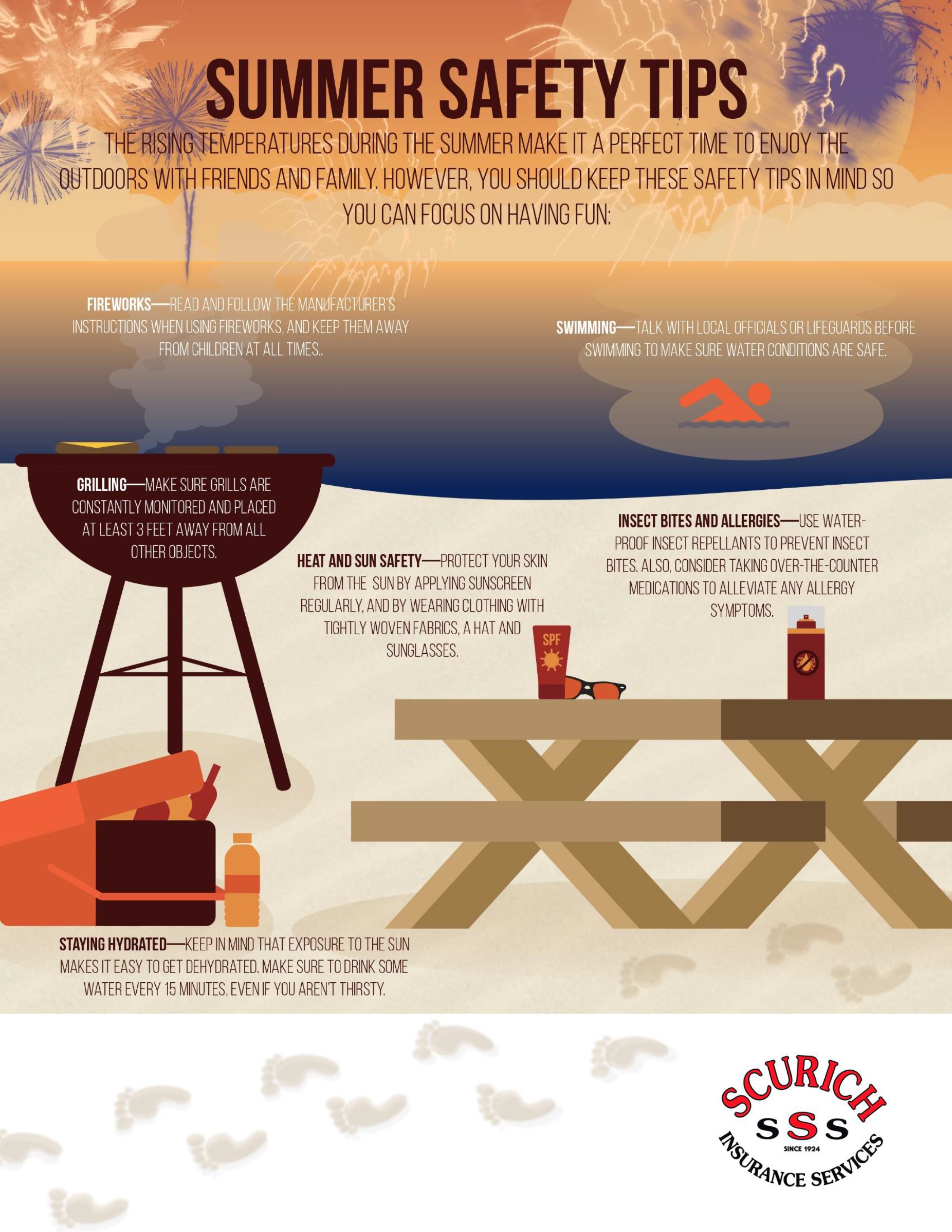
The rising temperatures during the summer make it a perfect time to enjoy the outdoors with friends and family. However, you should keep these safety tips in mind so you can focus on having fun.
Fireworks
Read and follow the manufacturers instructions when using fireworks, and keep them away from children at all times.
Swimming
Talk with local officials or lifeguards before swimming to make sure water conditions are safe.
Grilling
Make sure grills are constantly monitored and placed at least 3 feet away from all other objects.
Heat and Sun Safety
Protect your skin from the sun by applying sunscreen regularly, and by wearing clothing with tightly woven fabrics, a hat and sunglasses.
Insect Bits and Allergies
Use water-proof insect rellants to prevent insect bits. Also, consider taking over-the-counter medications to alleviate any allergy symptoms.
Staying Hydrated
Keep in mind that exposure to the sun makes it easy to get dehydrated. Make sure to drink some water every 15 min, even if you aren’t thirsty.
Read more
