For the unprepared, workers’ compensation (WC) issues can be both confusing and costly. Fortunately for employers, there are ways to actively engage WC issues to influence their outcomes.
Through management controls and active involvement in the WC process, your organization can effectively influence related costs. To do so you will have to establish a number of your own processes that guide decision making throughout your organization.
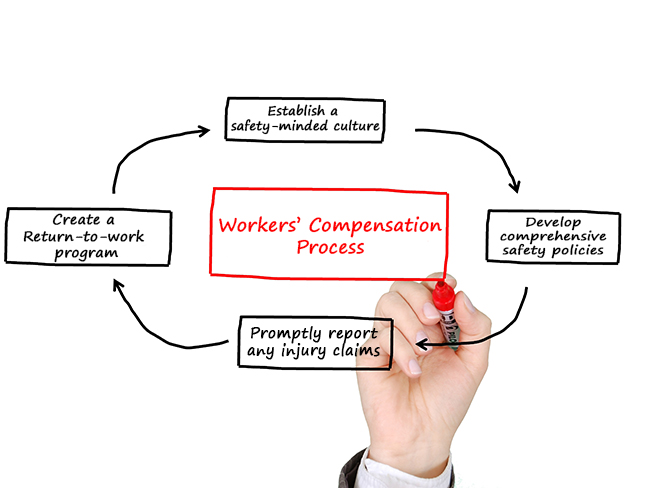
By developing a cohesive workers’ compensation process, you can play an active role in reducing related costs.
Areas requiring WC management can be divided into three main categories. These categories include facets that may range from the simple to the complex, but as a whole, address vital issues that can negatively influence WC costs in your company.
Workplace Safety Means Fewer Claims
Simply put, reducing claims reduces costs. Establishing a safety-minded culture throughout every level of your company is essential to keeping workers injury free. However, establishing such a culture isn’t an overnight solution. To be successful, an ongoing commitment to safety must be made. Such a commitment must be supported by management and given the necessary resources to succeed.
Developing comprehensive safety policies for employees builds a firm foundation for your safety culture to grow. Such policies also encourage OSHA compliance, further improving your safety efforts while helping you avoid costly fines.
Mitigate Loss After an Injury
Unfortunately, even with all the right programs in place, it is still possible for accidents to happen. When a workplace incident occurs how you respond can greatly influence the outcome of the claim. Prompt claim reporting is essential to keeping costs down.
It is also important to have a designated injury management coordinator, someone who can supervise open claims and work with both employees and medical personnel to facilitate the timely recovery.
The longer an employee is out of work the more expensive their claim will be. Return-to-work programs that allow injured employees to come back to work at a limited capacity during the recovery process, are one of the most effective tools business owners have to reduce the severity of a claim.
Managing Your Mod
Insurers use what is known as an experience modification factor, or mod, to calculate the premiums you pay for workers’ compensation coverage. By managing your exposures and promoting safety it is possible to manage your mod and decrease your premium rates.
Like a good safety program, controlling your mod is an ongoing process. To reap the benefits of lower premiums you will have to keep in regular contact with your insurance provider to ensure they have the most accurate data to use in their calculations.
Read more
McAfee Report Projects Top Cyber Threats of 2016
The McAfee Labs 2016 Threat Predictions report identifies top threats for the coming year as well as predictions for future cyber threats through 2020. The following is a summary of the report’s findings:
Hardware
Attacks that exploit flaws in both hardware and firmware components are expected to continue; security experts recommend being mindful of this potential avenue of exploitation below the level of the operating system.
Ransomware
Target Agrees to Pay a Nearly $40 Million Settlement
Target has just agreed to settle another huge class-action lawsuit stemming from the retailer’s 2013 data breach. Read on to learn who is getting paid and just how costly that data breach has been for the company.
Target has agreed to pay $39.4 million to settle a class-action lawsuit stemming from its 2013 data breach. The suit was filed on behalf of card issuers, banks and credit unions that had to give new cards to customers after their data was stolen from the retailer. This is just one of a number of lawsuits that have been filed since the data breach, and Target claims that it’s paid about $290 million in costs related to the breach.
Survey Finds Global Companies Worried About Cyber Threat Detection and Defense
According to EY’s Global Information Security Survey (GISS) 2015, “Creating trust in the digital world,” 88 percent of global organizations believe that their information security architecture doesn’t meet their current security needs. In fact, 36 percent aren’t confident that they even have the ability to detect sophisticated cyber attacks.
When asked about the source of cyber attacks, respondents named criminal syndicates (59 percent), employees (56 percent) and hacktivists (54 percent) as their top concerns. To meet this threat, 69 percent of respondents said that they’d like to increase their cyber security budgets by as much as 50 percent.
Cyber Information Sharing Act Passed as Part of Spending Bill
The Cyber Information Sharing Act (CISA), a significant piece of cyber security legislation, was added to the omnibus spending bill passed by Congress and signed into law by President Barack Obama last month. CISA is designed to encourage companies to cooperate with one another and with governmental agencies when disclosing and sharing information about identified cyber security threats, in part, by offering immunity to companies as a result of sharing that information.
Proponents of CISA say that sharing information will allow both the government and the private sector to respond to threats more quickly and efficiently. Critics, however, worry about the privacy of sensitive customer and patient data.
Ransomware attacks will likely become more common and more sophisticated. “Ransomware-as-a-service” is expected to continue growing, which will allow inexperienced cyber criminals access to the ransomware. Additionally, experts predict that ransomware will expand beyond Windows and also start targeting the increasingly popular Mac OSX.
Wearables
Wearable devices are becoming much more popular. While these devices don’t store very sensitive data themselves, they do connect to smartphones via Bluetooth, offering criminals a new potential “back door” into a user’s smartphone. The report suggests that cyber criminals might, for instance, use GPS data gathered from a user’s fitness tracker to create spear-phishing email attacks that the user is more likely to open.
Automobiles
Wired magazine stunned the automotive world in July 2015 when it ran a feature story outlining how a couple of enterprising hackers remotely commandeered a Jeep Cherokee. Experts predict a rise in the number of exploited zero-day vulnerabilities, but even identified threats pose a problem, because some companies cannot issue remote updates to certain car models.
Integrity
Integrity attacks represent a new, and potentially costly, type of cyber attack that most companies have seen in the past. Unlike other cyber attacks in which criminals simply damage or steal data, integrity attacks involve criminals selectively and surgically altering data in communications or transactions in ways that benefit them.
Experts anticipate integrity attacks will heavily affect the financial sector in 2016 as criminals find methods of intercepting and redirecting their targets’ legitimate transactions to their own bank accounts.
The report also mentioned that employees’ home systems, Cloud services and cyber espionage are likely cyber threats in the coming year. Regardless of the source, it’s clear that guarding yourself from cyber attacks involves identifying your exposures and developing strategies to protect yourself from each developing risk. Contact your advisor at Scurich Insurance today to ensure your cyber risks are appropriately covered.
Moody’s to Consider Cyber Attacks in Credit Assessments
Moody’s Investors Service announced recently that cyber attacks are becoming a larger part of the agency’s credit assessment and analysis processes. While Moody’s made it clear that it doesn’t consider cyber risk a principal credit factor, the agency has begun assessing cyber attacks as “event risks.” An event risk is a rare but potentially severe risk, much like a storm or other natural disaster that the company includes in its stress tests as it runs its credit analyses.
The growing number and severity of cyber attacks have made such a move necessary, as companies find themselves sometimes paying hundreds of millions of dollars to counteract the damage of a single data breach. Moody’s has released a report highlighting three important areas for companies to think about when considering the credit impact of a cyber attack:
- The type and importance of the affected asset or business
- The duration of the service disruption
- The scope of the business or assets affected by the cyber attack
For help assessing your cyber liabilities, contact Scurich Insurance today.
Read more

Social media and networking websites are extremely popular. Creating a social media presence for your company is something that should be thought through carefully, taking into account many factors. Interacting on social media just because “everyone else is doing it” is not a good enough reason when you consider the risks social media presents. However, the benefits can include the ability to help your company connect with tech bloggers, current and future clients, and potential job candidates.
Social networking has the ability to get your message across to thousands of people very quickly, which makes it a priceless public relations and viral marketing tool. However, popular social networking sites, such as Facebook, MySpace and Twitter, can present a significant hazard to your company and its reputation, depending on how you and your employees use them.
Social networking sites can help your company connect with clients and recruit job candidates. The key to social networking is to use it in a way that not only gets your name out there, but maintains a positive image of your company.
Industry leaders are constantly recommending social networking sites as places to advertise, and as tools to interact and connect with current and future customers. Although, not all publicity is good publicity. It is important to project a positive company image, which you can do through setting up your own social networking account; but it is just as imperative that you control other users’ conversations about you.
What Others Are Saying About You
Facebook, the largest social networking site today based on monthly unique visitors, has more than one billion active users. According to Facebook’s user statistics, the fastest-growing group of users is people older than 35, which means it is becoming increasingly likely that your workforce is getting involved with social networking.
While this has many potential benefits, you also want to be careful no one — whether it is a competitor, former or current employees — is tarnishing your company’s name or reputation. The same holds true for blogs, where damaging content may appear without your consent.
The key to keeping your risk low is identity management. The best way to prevent Internet buzz from becoming a hazard is to monitor the use of your company name. Set up an alert or periodically type it into a search engine to make sure that your official website is the top hit and that nothing offensive comes up in the first 20 hits, which is statistically as far as most people will dig in a search.
If you do find references to your company name in the first 20 hits that could be hazardous to your business or your reputation, you have a few options. If social networking sites are the culprit, consider enacting a policy prohibiting employees from mentioning the company name on their personal sites. Explain the negative outcomes this could have for business and help employees understand how acting as poor representation of the company through scandalous photos or negative comments on a social networking site could affect them directly.
How to Handle the Negative
If negative or derogatory comments about your company have seeped into other sites outside the control of your employees, however, the risk to your business is even greater. What’s more, this type of hazardous publicity is more difficult to manage. One approach is to try to increase the amount of positive information about your company on the Internet so that the negative write-ups are no longer within the top search results. Contacting sites and asking them to remove fictitious and defamatory material is another option.
If you have a serious public relations issue and your company’s reputation or legitimacy is on the line because of material on the Internet or social networking sites, it could cost you thousands of dollars in lost business. Consider hiring an identity management or public relations company, which will help organize, analyze and control the information about your organization that appears on the Internet.
Using Social Networks to Learn More About Candidates
The practice of using social networking sites to further research potential employees and weed out candidates based on content in these sites is risky. Not only does it cause you to dabble in issues of legality, but it also could place you in thorny situations when it comes to personal differences you become aware of via social networking tools.
A study conducted by Harris Interactive for CareerBuilder.com revealed that 45 percent of employers are already using social networking sites to screen job candidates. This is nearly double the number of employers who did this one year ago. Before you engage in this practice, know what types of hazards you face.
The most obvious problem with this practice is how difficult it is to draw lines between appropriate and inappropriate behavior. According to the Harris Interactive study, more than half the employers interviewed said provocative photos on a social networking site were the largest contributing factor when a potential employee was not hired.
But who gets to define what constitutes provocative, and does the candidate have the right to find out this is the reason he or she was not hired? Social networking is such a new trend, especially among the older workforce, that there are currently no ethical benchmarks in place.
By using social networking sites as a filtering tool, you are exposing yourself to potential lawsuits. Many users post personal information such as their religion and age. Even if you decide not to hire them for legal reasons, such as improper educational qualifications, the candidate could accuse you of basing the decision not to hire on information obtained from their social networking site.
There is no right or wrong answer regarding whether Internet research on candidates is a good idea, so it is up to your company to weigh the options. Whatever you choose, remember to examine the underlying risks and consider all feasible scenarios and outcomes to make the most informed decision possible.
Please contact Scurich Insurance for more information about this increasingly popular trend.
Read more

Insight for business owners and risk managers.
After assessing your company’s risks, you’ve made the decision to purchase directors and officers (D&O) insurance. Now what?
It’s essential to know the ins and outs of your D&O policy, including policy limits, what’s covered, and, most importantly, what’s not. Why? Because you may assume you’re covered for a claim when policy exclusions could apply. As time-consuming as it may be, it’s critical to read the fine print in your policy, as the language in the exclusions may affect the coverage of potential claims.
Types of Exclusions in D&O Policies
Some exclusions that insurers and insureds dispute about concern incidents that happened or allegedly happened before the D&O policy went into effect. In some cases, the insurer simply won’t cover the claim; in other cases, the insurer may render the policy void:
The known circumstances exclusion: With this exclusion, the insurer will not pay for claims that arise from a negligent act, error, omission or personal injury that occurred prior to the start date of the D&O policy. The insurance carrier attests that the insured knew or could have foreseen that any of the above happened and could have been the basis for a claim.
This exclusion is found more frequently in private and nonprofit policies than in public company policies. What is especially important to note is that the premium is usually not returned to the insured if it is determined that they withheld their knowledge of circumstances that occurred prior to the start of the policy.
Rescission: The premium is returned to the insured. Rescission means that the policy is rendered void after the insurer discovers that the insured answered untruthfully to any of the warranty questions on the insurance application.
Warranty questions ask the applicant if they know of any fact, circumstance or situation that might reasonably be expected to give rise to a claim. Rescission also can occur if the applicant provided false or misleading information in the company’s financial data. These scenarios usually happen only in public company D&O policies.
Prior acts exclusion: Similar to the known circumstance exclusion, this exclusion is also concerned with pre-policy circumstances. The insurer is not responsible for wrongful acts committed or attempted before the coverage was enacted. A wrongful act is that which damages the rights of another. These acts are not only limited to criminal offenses, but can also include acts that result in civil lawsuits.
Other exclusions found in D&O policies revolve around the duty to defend and defense expenses in the event of a claim. If the insurer has the right to the duty to defend, then they are able to select the insured’s defense and have greater control over the rates and billing practices of the defense counsel:
Reasonableness of defense fees: This is more prevalent in private company and nonprofit D&O policies, as most of those policies give the insurer the right and duty to defend the insured’s claims; whereas, public companies retain the right to choose their own defense counsel. If this is written into your D&O policy, it means that the insurer will only pay for “reasonable and necessary” defense fees. Some insurers also provide detailed information on litigation guidelines.
Consent to settle and the hammer clause: If the insurance carrier has no duty to defend, such as in cases against public companies, then they have no right to settle the case when they want to settle it. As a result, the insured may elect to continue with litigation, even if that would exhaust the policy limit, because the defendants don’t want settling the case to be perceived as an admission of their wrongdoing or incompetence.
This creates a lot of tension between insurers and the insured, especially if the insured does not include the insurer in the settlement discussion. Therefore, some insurance policies have a consent to settle exclusion in the policy, prohibiting the insured from settling the claim without the insurer’s prior written consent.
The hammer clause is similar to the consent to settle exclusion, although less common. Basically, the hammer clause informs the insured that if they go against the insurer’s recommendation to settle, the insured will be responsible for any judgment won by the plaintiff plus legal fees that go beyond the settlement offer.
Most D&O insurers expect that D&O insurance is only a part of a company’s wider insurance portfolio. In some cases, however, this assumption doesn’t always prove to be true. Certain firms may go without umbrella insurance or even general liability insurance policies, making D&O one of their only forms of insurance.
Because of this, many D&O insurers write exclusions in their policies stating what claims they won’t cover because other types of insurance would potentially cover the claim:
“Other insurance” exclusions: D&O insurance is just one form of insurance in a comprehensive risk management plan for most companies. Because of this, most D&O policies have exclusions for claims that involve bodily injury, property damage and Employee Retirement Income Security Act (ERISA) claims, which could be covered by other types of insurance such as a commercial general liability policy or a fiduciary liability policy.
To protect their best interests in the event of a claim, the insured should notify all insurers from their various policies, thus allowing the insurers to determine who is liable for the claim.
Contractual liability exclusion: This exclusion is especially pertinent to private companies and nonprofits that have broad entity coverage under a D&O policy. Since contractual obligations are not liabilities imposed by law but rather an obligation that is voluntarily undertaken, many D&O policies have an exclusion that prevents insurers from having to cover contract-related claims, especially breaches of contract that arise when the company enters into a contract with another party.
When examining this exclusion in your D&O policy, make special note of the wording of this clause. This exclusion can substantially affect the extent of your coverage under the policy—the narrower the scope of the exclusion, the better for you.
D&O insurance protects directors and officers from poor business decisions, but most policies do not protect them from wrongful acts and gross misconduct. These exclusions include the following:
Conduct exclusions: Most D&O policies have exclusions that deny coverage for certain types of misconduct. There are two categories of misconduct exclusions:
- For loss relating to fraudulent or criminal conduct
- For loss relating to illegal profits or remuneration to which the insured was not legally entitled
It’s especially important to look at the wording on these exclusions in the policy; subtle wording differences can significantly affect the accessibility of the coverage.
Insured versus insured exclusion: In some D&O cases, one insured director may bring a claim against another insured director, and some insurers do not want to cover this because they don’t want to get involved in the infighting between a company’s directors and officers.
However, with recent changes to the whistleblower provision of the Dodd-Frank Act, most insurers are now agreeing to cover insured vs. insured claims if the whistleblower is also one of the insured directors.
Obtaining D&O insurance is important to protect the directors and officers of your company; but simply purchasing the policy won’t benefit you unless you know the extent of your coverage.
Do you understand your D&O insurance policy? Contact Scurich Insurance today for more information about your coverage and exclusions.
Read more

In the event that someone is injured on your property and you are found legally responsible, you could be faced with a costly financial burden. In fact, without a personal umbrella liability insurance policy, any expenses beyond the limits of your standard policy are your responsibility. This applies to your homeowners, renters, automobile and watercraft insurance policies.
Personal umbrella liability insurance provides an extra layer of protection over your personal assets for when your standard liability coverage is exhausted.
Engaging in everyday activities can put you at risk for a lawsuit. Simple things like having a swimming pool or entertaining guests in your home can increase the chance that someone will get injured and sue you. To minimize your risk, consider a personal umbrella liability policy.
Why is a personal umbrella liability policy important? It works to fill the gaps in your coverage and provides the following benefits:
- When litigation ensues, it’s typically for a large amount. If you get into a car accident and injure several people, you could be sued for millions of dollars; well beyond the limits of your automobile policy. You can also be held responsible if your dog bites someone, if your child injures another kid in a fight at school or if a handyman hurts himself at your home.
- Umbrella policies cover legal fees because the insurance company assumes the risk, not you.
- Coverage is inexpensive and easy to obtain. Just give us a call to add it on to your current policy.
- You’ll have peace of mind knowing that you are covered in case of a fluke occurrence.
How much coverage do you need? Take into consideration your total personal assets and your potential for personal risks when determining how much coverage you need.
A wide range of factors, such as whether you have hired help, if you have teen drivers at home or if you operate your business out of your home, will determine how much coverage is appropriate for your circumstances.
What are the policy limits? A $1 million limit is typical and higher limits are available.
Contact us today to determine how much coverage is right for you.
Read more

The Virginia Graeme Baker Pool and Spa Safety Act addresses dangers related to pool and spa drains, which can cause severe injury or death by trapping swimmers under the water when blocked. The Act is designed to improve pool and spa safety through new federal requirements for drain covers and anti-entrapment systems as well as by establishing educational programs.
Federal Requirements
The Act contains the following federal standards for swimming pool and spa drain covers:
Your business should follow all pool and spa safety requirements to lower risk.
- All covers manufactured, distributed or sold in the United States must conform to the specified entrapment protection standards.
- All must be equipped with anti-entrapment devices or systems that comply with the same federal standards.
- Each public pool and spa in the country with a single main drain (other than an unblockable drain) must be equipped with at least one device or system designed to prevent entrapment, such as a safety vacuum release system, suction limiting vent system or gravity drainage system, that meets appropriate performance standards.
The requirements contained in the act are intended to be minimum standards; many states have more rigorous safety rules. Violations of the act’s requirements will be treated as violations of the Consumer Product Safety Act.
State Swimming Pool Safety Grant Program
A grant program exists that provides financial assistance to states that have minimum safety requirements for pools and spas that meet the standards contained in the Act. The state statute must require pool and spa owners to:
- Enclose all outdoor, residential pools and spas with barriers to prevent small children from gaining unsupervised access to the area
- Equip all pools and spas with anti-entrapment devices
- Equip all pools and spas built after Dec. 19, 2008 with more than one drain, one or more unblockable drains, or no main drain with anti-entrapment devices
- Equip every swimming pool and spa that has a main drain with a drain cover that meets standards
In addition to imposing these safety requirements, the state law must require periodic notification to owners about compliance with the entrapment protection standards. States can use the grants for the following purposes:
- Hiring and training enforcement personnel for implementation and enforcement of the state laws
- Educating pool construction, installation and service companies about the safety standards
- Educating pool owners, pool operators and other members of the public about the safety standards
Education Program
The act also established an education program to inform the public of methods to prevent drowning and entrapment in swimming pools and spas. The educational materials are designed for pool owners and operators to promote safety.
Please contact Scurich Insurance at (831) 661-5697 with any questions regarding risks and liabilities associated with your business’ pool or spa.
Read more
