Even though farm machinery manufacturers try to ensure that their products are safe by equipping them with safety guards, agricultural work presents many hazards. Many times, workers suffer injuries because of human error from taking a shortcut, ignoring warning signs, not paying attention or not following safety rules.
Here are some of the most common farm machinery hazards, as well as several safety recommendations to reduce your risk of injury:
Shear Points and Cutting Points
- Shear points occur when the edges of two objects move close together and can cut soft material (example: auger).
- Cutting points occur when an object moves forcefully and is able to cut (example: sickle blade).
To avoid injuries, remain alert while operating machines with shear and cutting points. Also, advise others to watch out because some cutting machinery can throw objects while in use.
Pinch Points
- Pinch points are created when two rotating objects move closely together, one moving in a circle.
- Hands and feet can get caught in pinch points, or other body parts can get pulled into pinch points when loose clothing becomes entangled in the machine.
To avoid injuries, wear tight-fitting clothing and never reach over or work near rotating parts. Also, identify places where pinch points can occur and avoid these areas.
Wrap Points
- When exposed machine parts rotate, they create wrap points. Loose clothing can get caught in the moving parts, and consequently pull workers into the machine.
To avoid injuries, shield potential wrap points before beginning your work. If wrap points cannot be shielded, paint them a bright color to remind yourself that they are there.
Crush Points
- Crush points occur when objects move toward one another, or one object moves toward a stationary object. Workers can be crushed in between.
Block equipment securely to avoid fatal crushing injuries.
Free-wheeling Parts
- Some equipment with moving parts continues to spin after being shut off.
To avoid injuries, wait until the machinery has completely stopped before touching it. This can take several minutes.
Hydraulic Systems
- When servicing, adjusting or replacing parts on machines with hydraulic systems, workers can face high-pressure blasts of hydraulic oil. This can cause injury and/or burns to the skin.
To avoid injuries, do not inspect hydraulic hoses with your hands because the hydraulic fluids can puncture the skin.
Take time to become familiar with the potential hazards of the machinery you work with and remember to always put safety first!
Read more

In today’s high-tech world, individuals can carry thousands of client files on flash drives in their pockets or purses. People are conducting business on the go and sensitive information is accessible at the click of a button. Managers are using their laptops or tablets through “hot spots” at local coffee shops to access customer databases. Healthcare professionals shopping at supermarkets can get patient files on their smartphones.
If you think of information security breaches primarily in terms of malicious hackers cracking the networks of big corporations from thousands of miles away, think again.
The hacking of such corporate giants as Global Payments, Epsilon, and Sony prove that size and sophistication can’t stop data thieves. However any company that stores customer information in electronic format is vulnerable to cyber privacy liability exposures than can cost megabucks – or even put a firm out of business – which means they need insurance against these risks.
Cyber Liability coverage can protect your business against breaches of privacy from unauthorized access, physical taking, or the mysterious disappearance of confidential information that leads to third-party losses resulting from identity theft.
Depending on your needs, the policy can also provide a variety of coverages, such as:
- Business Interruption
- Cyber Extortion
- Systems and Data Recovery
Other options can cover the cost of contacting those affected by the data breach, computer forensics to analyze the breach, fines and penalties, potential HIPAA (client medical records) exposures, and online activities on your company site.
The development and expansion of Cyber Liability coverage during the past two decades has paralleled the explosive growth of computer technology: Today’s policies are increasingly comprehensive – and inexpensive. Contact us today to discuss your Cyber Liability Insurance needs.
Read more

If an employee is away, restricted or transferred for an extended period of time, follow these guidelines for completing the OSHA 300 form:
- Enter an estimate of the days the employee will be away.
- Begin counting days on the day after the injury occurred or the illness began, and update this number when you know the actual number of days.
- The count of days away from work ends on the date the physician or other licensed health care professional recommends that the employee return to work, whether or not the employee returns earlier or later than that date.
- When there is no physician recommendation, enter the actual number of days the employee is off work.
- Include weekend days, holidays, vacation days or other days off in the number of days recorded if the employee would not have been able to work on those days due to a work-related injury or illness.
- When the number of calendar days away from work or days of job transfer or restriction is greater than 180, enter 180 in the “Total Days Away” column.
- If an employee leaves the company for a reason unrelated to the injury or illness, stop counting days away from work or restriction/job transfer.
- If an employee leaves the company because of the injury or illness, estimate the total number of days away or days of restriction/job transfer and enter that estimate.
- Log the number of days away only on the 300 Log for the year in which the incident occurred.
- If the employee is still away from work because of the injury or illness when you prepare the annual summary, estimate the total number of calendar days you expect the employee to be away from work, use this number to calculate the total for the annual summary and then update the initial log entry later when the day count is known or reaches the 180-day cap.
- Never split the number of days between years and enter two amounts for two different years. Only record each injury or illness once.
Read more
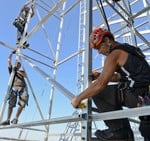 A resurgent construction industry needs to do a better job of keeping workers safe. That’s the bottom line of a recent report by Marsh Risk Consulting.
Based on data from the U.S. Bureau of Labor Statistics, the study, “Building Safety and Leadership in the Construction Industry,” notes that the industry’s 2012 fatality rate increased to 9.5 per 100,000 workers from 9.1 per 100,000 in 2011. The 775 construction-sector deaths in 2012 marks the first annual increase in work-related fatalities since 2006.
According to Marsh, fatalities will probably continue to rise without concerted industry-wide safety improvements, as an ongoing shortage of experienced construction workers leads to widespread promotion of unskilled workers into supervisory roles. “The increase in new construction activity is bringing an influx of new, inexperienced workers,” states the report. “In this environment, some contractors are stretching their hiring standards to meet project demands.”
Marsh recommends that construction firms focus on training management to ensure effective leadership and help build a culture of safety throughout their organizations.
“As the economy grows and the number of new construction projects picks up, now is not the time to be lax on safety,” warns John Moore, a construction safety specialist in Marsh’s workforce strategies practice. “Inadequate safety performance can lead to employee turnover and legal, financial and reputational risks. Investing in high-quality leadership will go a long way toward retaining valued workers and maintaining a safe work environment.”
The more you do to keep your workers, safe, the better for all concerned– and the lower your insurance costs. We stand ready to offer our advice on developing, implementing, and enforcing workplace safety standards. Just give us a call.
Read more
 It’s frustrating when you suspect that a Workers Compensation claimant is milking the system. However, you can reduce potential malingering significantly if you attend to it from the get-go.
Start by designating a manger as the “firm’s rep,” to ensure that any employee who makes a Comp claim gets a doctor promptly and to inform your insurance company immediately. The rep should transport the employee to the physician, stay at the office during the examination and treatment, and then take him or her home or back to work.
While at the doctor’s office, the firm’s rep should ask the physician about the medical condition, recommended treatment, and a reasonable return-to-work date. If the claimant or physician objects, the rep should assure them that he or she will work with the insurance company to make sure all reasonable and necessary benefits and medical bills are paid.
Resist any employee excuses for not seeing a doctor. If the employee has an attorney, suggest getting a second opinion (which you will provide at no cost). If the claimant already has a doctor, have the firm rep offer to take him or her for a consultation– and ask about diagnosis, treatment, and return-to-work status.
The rep should then: 1) follow up with the employee at least every two weeks – and more often if possible – face to face or by phone; and 2) stay in touch with the claims adjuster to share information about visits with the doctor and claimant that might help him or her return to work as early as possible.
Although these techniques won’t always work, anecdotal evidence suggests that they can reduce malingering claims by up to 70%.
What’s not to like?
Read more
 As people retire later, the workforce keeps aging. This trend has been a concern for businesses because the conventional wisdom holds that older workers are more vulnerable to costly injuries, driving up Workers Comp rates.
However, new research from the National Council on Compensation Insurance (NCCI) casts doubt on this conclusion, changing the definition of “older workers.”
After studying injury rates for different age groups, NCCI found that, while workers under 35 had substantially more cuts on their fingers and those over 35 suffered more cases of carpal tunnel and cervical injuries, the numbers are startlingly similar.
What about expense? NCCI concluded that although workers between 20 and 34 create much lower costs (and fewer days lost), once they reach 35 these costs are similar. This redefines an “older worker” as someone who grew up listening to Nirvana instead of Elvis.
Injury prevention for employees – regardless of age –should begin during the hiring process. Once you have a written job description, offer the candidate the job based on his or her ability to do the work with reasonable accommodation. Then have the candidate complete a medical questionnaire to determine if he or she “fits” position. If so, it’s time to get started. If not, to find someone else.
If you haven’t already done so, set up and monitor a comprehensive safety-training program for new hires, Make sure that they remain mindful of how they’re doing their job. Far more injuries result from unsafe acts by employees than unsafe workplace conditions Employees who feel rushed are more likely to ignore safety aside so they can meet deadlines – leading to preventable accidents.
To learn more about keeping your workers safe on the job, feel free to get in touch with us.
Read more