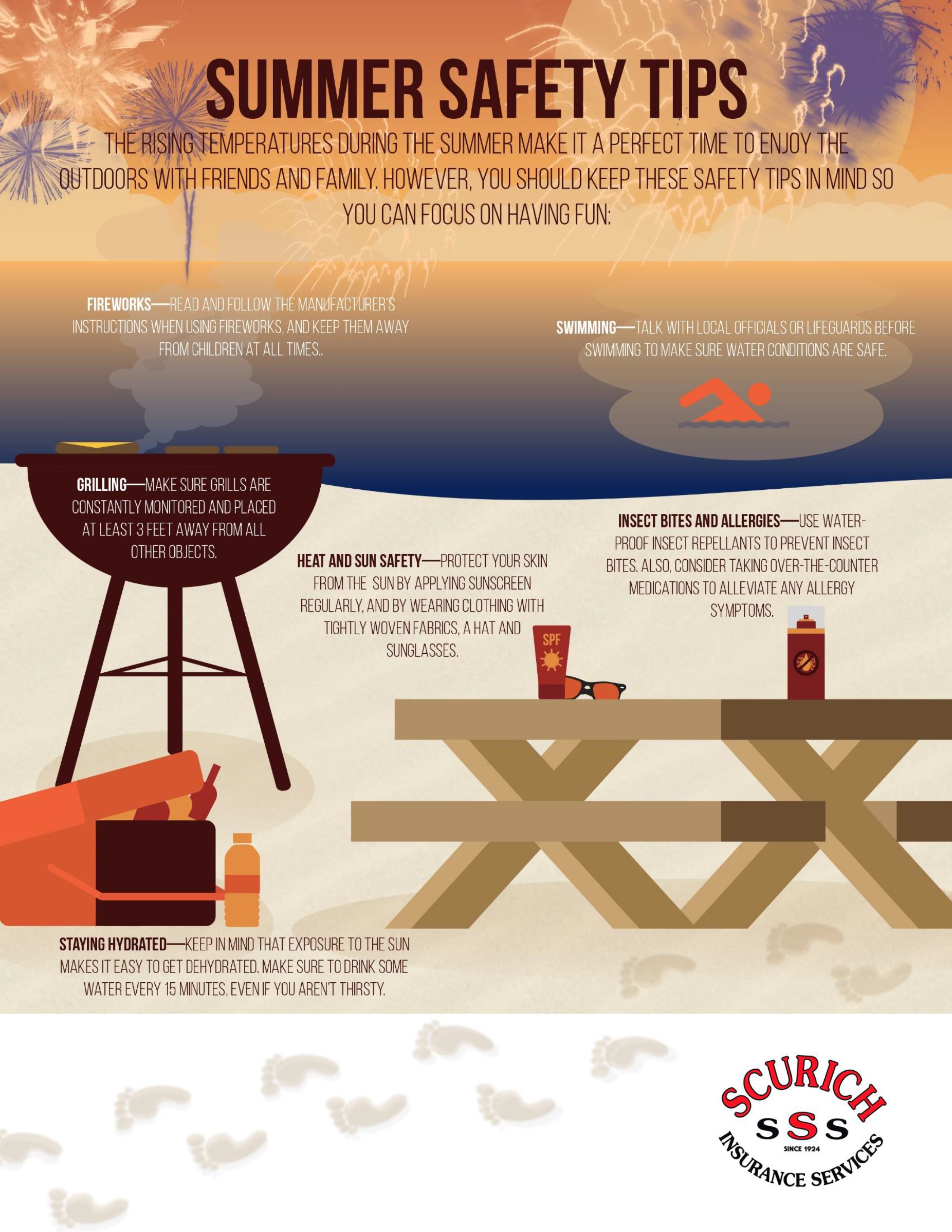
The rising temperatures during the summer make it a perfect time to enjoy the outdoors with friends and family. However, you should keep these safety tips in mind so you can focus on having fun.
Fireworks
Read and follow the manufacturers instructions when using fireworks, and keep them away from children at all times.
Swimming
Talk with local officials or lifeguards before swimming to make sure water conditions are safe.
Grilling
Make sure grills are constantly monitored and placed at least 3 feet away from all other objects.
Heat and Sun Safety
Protect your skin from the sun by applying sunscreen regularly, and by wearing clothing with tightly woven fabrics, a hat and sunglasses.
Insect Bits and Allergies
Use water-proof insect rellants to prevent insect bits. Also, consider taking over-the-counter medications to alleviate any allergy symptoms.
Staying Hydrated
Keep in mind that exposure to the sun makes it easy to get dehydrated. Make sure to drink some water every 15 min, even if you aren’t thirsty.
Read more

Employee Drug Use Reaches 12-year High
The positive drug test rate for the U.S. workforce was 4.2 percent in 2016, according to the Drug Testing Index (DTI) released by Quest Diagnostics. This represents a 5 percent increase over the positive rate in 2015, and the largest single-year positive rate since 2004.
The DTI analyzed over 10 million workforce drug test results from 2016 and categorized employees into three categories, including employees with federally mandated drug tests, the general workforce and the combined U.S. workforce. Here are additional details about the DTI’s findings for specific drug types:
- Marijuana—The positive test rate for marijuana increased nearly 75 percent in oral fluid testing, which is used in the general workforce. Federally mandated marijuana tests only utilize urine tests, and the positive test rate increased 10 percent in 2016.
- Cocaine—Positive test rates for cocaine in post-accident drug tests were more than twice as high as pre-employment screenings.
- Amphetamines—Positive test rates for amphetamines have risen 64 percent between 2012 and 2016 for the general workforce. Quest Diagnostics attributes this increase to the prevalence of prescription drugs, including Adderall.
In order to create a safe, productive workplace, you need to watch out for potential drug use at your business.
Political Discussions Hurt Job Performance
Many people can get worked up about politics, but a new survey from the American Psychological Association (APA) has shown that political discussions in the workplace can have a big impact on your employees’ job performance.
The APA surveyed U.S. employees about the impact of political discussions after the 2016 presidential election, and found that these discussions have a detrimental effect on job performance and relationships with co-workers. The survey found that 40 percent of employees have experienced a negative outcome following a workplace political discussion, such as reduced productivity or difficulty getting work done. Additionally, 24 percent of employees said they avoid some co-workers solely because of their politics.
According to the APA, social networks and constant news reports can cause individuals to adopt an “us versus them” political mentality, which can lead to conflict. As a result, it’s important to encourage respect, collaboration and courtesy in your workplace to ensure that your employees feel supported and remain productive.
New Executive Order Aims to Improve Cyber Security
President Donald Trump recently signed an executive order to improve the country’s cyber security and protect key infrastructure from cyber attacks. The order also emphasized the importance of strengthening the cyber security of federal agencies. According to a survey from Thales Group, a cyber security company, 34 percent of federal agencies experienced a data breach in the last year, and 95 percent of agencies consider themselves vulnerable to cyber attacks.
The executive order did not create any ongoing cyber security requirements, but instead laid out goals to assess the current state of cyber defenses and develop deterrence strategies. Here are some of the requirements of the executive order:
- Federal agencies must draft reports on their ability to defend themselves against cyber threats.
- The departments of Energy and Homeland Security must assess potential vulnerabilities to the country’s electrical grids. The executive order specifically mentions that prolonged power outages could pose a threat to national security or damage the economy.
- Various federal agencies must review the cyber defense plans of U.S. allies in order to cooperate during international cyber attacks.
Apple Creates $1 Billion Fund to Support U.S. Manufacturing
Apple, the world’s largest technology company, recently announced that it will create a $1 billion fund to support U.S. manufacturing. Although the company is based in the United States, it has faced criticism for outsourcing most of its manufacturing and taking jobs from U.S. workers.
Apple’s CEO stated that one goal of the fund was to support smart manufacturing and to create a ripple effect in industries that support smart manufacturers. For more information on the manufacturing fund, visit Apple’s website.
DID YOU KNOW?
A U.S. Court of Appeals recently barred the Federal Aviation Administration (FAA) from requiring recreational drone owners to register their unmanned aircraft. The FAA had originally required recreational drones to be registered in order to help identify aircraft that posed a hazard, and to pass on safety information to operators. However, the court’s ruling will not impact the use of drones for commercial use, as these aircraft must still be registered with the FAA before they are used.
Read more

OVERVIEW
The Occupational Safety and Health Administration’s (OSHA) electronic reporting rule requires certain establishments to report information electronically from their OSHA Forms 300, 300A and 301. The rule also requires OSHA to create a website that can be used to submit the required information. Under the rule, the first reports are due by July 1, 2017.
However, on a recent update to its recordkeeping webpage, OSHA indicated it will not be ready to receive electronic workplace injury and illness reports by the established deadline. No new reporting deadline has been adopted yet.
ACTION STEPS
OSHA has not officially delayed the July 1, 2017, deadline, but its website will not be ready to receive electronic reports from employers by this time.
Affected establishments should continue to record and report workplace injuries as required by law and should monitor these developments to learn whether a new reporting deadline will be adopted.
HIGHLIGHTS
- The rule requires OSHA to create and provide a secure website to transmit electronic information.
- Under the rule, OSHA will publicize the information received from the electronic reports.
- The final rule has met significant opposition and its validity is currently being challenged in federal court.
IMPORTANT DATES
May 12, 2016
OSHA issues its final electronic reporting rule. The first reporting deadline is set for July 1, 2017.
May 16, 2017
OSHA indicates its reporting website will not be ready to receive the first reports by the July 1 deadline.
Read more

Responsible employers in the construction industry know the importance of implementing a safety and health program to prevent workplace injuries. Effective safety programs have seven core elements.
- Management leadership—provides the resources needed to implement an effective safety and health program.
- Worker participation—allows a program to benefit from the workers’ knowledge base and empowers workers to provide feedback.
- Hazard identification and assessment—identifies the root cause of construction injuries.
- Hazard prevention and control—helps employers provide workers with safe and healthy working conditions.
- Education and training—provides workers and managers with a greater understanding of the safety and health program.
- Program evaluation and improvement—verifies that the program is being implemented as intended.
- Communication and coordination for employers on multiemployer work sites—encourages employers and contractors to consider how the work they do can affect the safety of other workers at the job site.
The seven core elements are interrelated and are best viewed as an integrated system. Actions taken under one core element can, and likely will, affect other core elements. For example, the education and training core element supports the worker participation core element.
It is important to achieve progress in each core element in order to benefit from a safety and health program. Contact Scurich Insurance for more information regarding recommended practices for safety and health programs in construction.
OSHA Rescinds Walkaround Memo
OSHA has withdrawn its 2013 “Walkaround Letter of Interpretation” that allowed union officials to participate in inspections at nonunionized workplaces.
The letter was viewed by employers as an attempt by the Obama administration to support and expand union representation to nonunion workplaces. However, OSHA has now withdrawn the union policy language featured in the letter, calling it unnecessary.
OSHA compliance officers may still attempt to include outsiders to participate in a walkaround if there is good cause. One example of good cause would be due to the compliance officer lacking technical or language expertise that is necessary to the inspection. Such cases are rare, however, as OSHA usually provides the needed expertise from within the agency.
Read more

OSHA Program to Target Southern Auto Part Makers
OSHA has renewed a Regional Emphasis Program (REP) for auto part manufacturers in Alabama, Georgia and Mississippi. The REP was originally established to reduce workplace hazards in the auto parts industry, including electrical, struck-by, caught-in and crushing hazards.
Information released by OSHA revealed that the REP led to 46 safety inspections in 2016, which resulted in 143 violations. Now that the REP has been renewed, OSHA will continue to target auto parts manufacturers in the region for inspections.
Trump Administration Will Not Label China as a Currency Manipulator
President Donald Trump recently announced that his administration will not officially label China as a currency manipulator. This is a reversal from previous statements released by Trump, as he stated during his presidential campaign that he would take steps to label the country as a currency manipulator during his first days in office.
Many experts believe that the Chinese government artificially weakens its own currency to make its goods more affordable for American consumers. However, Trump recently stated that China hasn’t manipulated its currency in months, and that the current strength of the U.S. dollar is hurting exports of domestic goods.
This policy reversal is seen by some as a move to maintain China as an ally against North Korea after recent political unrest in the area. However, the decision to not label China as a currency manipulator has already had an impact. According to S&P Global Platts, an energy information provider, the stocks of 10 major U.S. steel producers fell after Trump’s announcement.
Cyber Insurance on the Rise in Manufacturing
Before now, cyber insurance has usually been purchased by consumer-facing businesses, such as health care providers, retailers and financial institutions. However, cyber attacks are now capable of taking control of manufacturing plants and products, and many businesses in the industry are purchasing cyber insurance policies to protect themselves.
According to Advisen, an insurance data provider, manufacturers paid nearly $37 million in cyber insurance premiums in 2016, an increase of 89 percent compared to 2015. Get in touch with us today at 831-661-5697 to discuss a cyber insurance policy and protect your business.
Read more

Professional liability insurance is essentially there to protect your reputation as a professional.
Things happen. There are unforeseeable circumstances that can botch even the easiest job in the most capable hands. When that happens, most contractors, consultants, professionals and business owners are more than happy to help cover the cost to the client, to injured parties and so on. That’s why the insurance policy is there.
Professional liability is there to protect specifically against claims of negligence by covering the court costs. These are the cases that we fight not because we don’t want to foot the bill, but because a reputation is on the line, and at the end of the day, all any professional really has to lean on is a trusted name. That is the foundation of success in any field. You can lose your office space, you can lose your clients, you can lose some of your best employees, and you can always rebuild from there. Once your name has been stripped of value, however, there’s not much left to do. Top talent will avoid the association with a negligent employer and clients and customers will jump ship.
These are the cases that you want to fight even at a financial loss. Even if you know that you’re not at fault for a visitor who suffered an injury on your property, it may make more sense to take responsibility than to fight it in court and spend more money in front of the judge than you would have on the doctor bill. The more comprehensive your professional liability policy, the less likely you are to have to do this when your reputation is on the line.
Of course, you can’t always have the case dismissed, so professional liability will cover the costs awarded to the plaintiff in a civil suit should you lose the case, meaning that you will be covered even where general liability coverage does not kick in. However, the real value in the policy is in allowing you to defend yourself against that civil suit in the first place, and, wherever possible, protecting your reputation within your industry.
Medical professionals rely on malpractice insurance for the same reasons, while insurers and lawyers will rely on errors and omissions, or E&O insurance. In any field where a professional mistake can prove incredibly costly or harmful, you will find some form of professional liability insurance being sold.
Read more
