
Softwood Lumber Prices Keep Climbing
As the lumber dispute between Canada and the United States continues, uncertainty over the softwood lumber supply has increased prices by more than 12 percent since January, according to a National Association of Home Builders (NAHB) analysis. Although the Trump administration is eager for a quick deal to end the dispute, the Canadian government doesn’t see an agreement any time in the near future.
In April, the U.S. Department of Commerce announced an average preliminary 20 percent import tax on Canadian softwood lumber. That could increase to 30 percent after a U.S. decision on new anti-dumping penalties, according to RBC Capital Markets.
The United States imports one-third of its lumber supplies, and more than 95 percent of that comes from Canada, according to the NAHB.
Trump Signs Apprenticeship Order
In an effort to fill some of the 6 million open jobs in the United States, President Donald Trump signed an executive order providing more money for private companies to design apprenticeship programs. The order nearly doubles the $200 million in taxpayer money spent on learn-and-earn programs under a grant system called ApprenticeshipUSA. To avoid using federal money to fund the order, Trump is directing a government review, hoping to streamline over 40 workforce programs across 13 agencies.
There are about 500,000 apprenticeship positions in the country, representing less than 1 percent of the entire U.S. workforce. The executive order addresses the nation’s “skills gap” that has left millions of open jobs unfilled. Apprenticeships would give students a way to learn skills without facing the debt associated with attending four-year colleges.
Critics are concerned about limited government oversight, since Trump’s order does not require all apprenticeships to be registered, and the Labor Department would review the apprenticeships under broader standards. They are also concerned about the oversight of apprenticeship programs that operate under private companies’ control.
Heat App Updated in Time for Summer
The National Institute for Occupational Safety and Health (NIOSH) and OSHA have recently redesigned their Heat Safety Tool mobile app. The free app provides information on what precautions outdoor workers should take to stay safe in hot and humid conditions.
The updated app uses a cellphone’s geolocation capabilities to gather weather data from National Oceanic and Atmospheric Administration satellites. It can forecast the hourly heat index and determine whether the user’s current risk level is minimal, low, moderate, high or extreme. The information can help employers adjust work schedules and workloads.
According to OSHA, more than 65,000 people seek medical attention each year for extreme heat exposure.
Read more

Summer Weather Safety Tips
Severe weather causes thousands of injuries and hundreds of deaths each year in the United States. Stay safe this summer by taking the following precautions:
- Create a disaster plan and a disaster supplies kit. Check the American Red Cross website for guidance.
- Identify a safe place to take shelter.
- Check the weather forecast before working outdoors.
- Set up severe weather alerts on your cellphone.
- Purchase a National Oceanic and Atmospheric Administration (NOAA)
“Weather Radio All Hazards” receiver unit with a warning alarm tone and battery.
Many Farmers Upset Over Cuba Policy
On June 16, 2017, President Donald Trump signed a presidential directive rolling back parts of former President Barack Obama’s efforts to improve the United States’ trade relationship with Cuba. Farmers saw the directive as a step backward, as it is expected to tighten restrictions on exports and complicate agricultural trade.
Shipments of U.S. grain and soy to Cuba have soared between 2016 and 2017, thanks to Obama’s 2014 diplomatic breakthrough. Within the first four months of 2017, the United States shipped 142,860 tons of grain and soy to Cuba, up from 49,090 tons during the same period of 2016. Although U.S. farmers have just gotten a taste of the profitability from exporting to Cuba, Trump’s move breakthrough is expected to cost U.S. farmers $125 million per year.
President of the U.S. Grains Council Tom Sleight said in a recent statement that, “Trump’s move could cut off near-term sales and stymie economic development that would drive longer-term demand growth.” Although the amount of exports to Cuba are small in comparison to total U.S. exports—corn exports were close to 56 million tons last year—every bit helps as farmers face a decline in farm income for the fourth consecutive year.
$20 Million Raised for Vertical Farms
Indoor agricultural startup Bowery has raised $20 million in Series A funding to build more farms, plant more crops and hire more people. The urban farming startup is one of many that intend to reimagine farming by growing produce vertically in warehouses across the country, as opposed to planting crops in sprawling fields that are reliant upon good weather.
Co-founder Irving Fain stated that since vertical farms can be built in any city, produce would be more accessible to customers and reach them more quickly.
According to Research and Markets, the vertical farm market is expected to grow to $5.8 billion by 2022.
Read more

Ever since the first ride-sharing app debuted in 2011, they’ve experienced exponential growth in usage. In fact, in the cities where such apps have joined the market, taxi ridership has declined anywhere from 10 to 30 percent. However, while the popularity of ride-sharing apps is increasing, so is the host of risks associated with using them. Most of the companies are in the stages of infancy, and the situations they’re facing are in uncharted territory.
How the Apps Work
While they’re most commonly referred to as ride-sharing apps, any company that uses an online platform to connect passengers with drivers (using the driver’s own vehicle) is called a transportation network company (TNC). These companies each have their own unique differences, but they all operate under the same basic concept.
Through their smartphones, passengers are matched with available drivers via GPS. Most apps display the driver’s route and estimated time of arrival, in addition to the driver’s name, photo and vehicle information. The TNC gets a cut of the fare, typically between 20 to 25 percent, for each ride a driver completes.
The apps are convenient for passengers and for drivers looking to supplement their income. Still, they’re not without flaws. For example, it can be difficult to determine what regulations the TNC and its drivers need to follow, what insurance coverages apply to them and who is considered liable in the event of an accident.
When Insurance Kicks in
Since TNC drivers use their vehicles for both business and personal purposes, TNCs have to clarify when drivers are covered by different types of insurance.
When a driver is driving with the TNC app off, the driver is not accepting rides, so the driver’s personal auto insurance is the primary coverage. When the driver turns the app on, but has not yet accepted a ride, TNCs generally offer contingent liability coverage if the driver’s personal auto insurance does not offer protection. When a passenger is picked up, the TNC’s policy is the primary policy until the end of the ride.
State Involvement
Unlike taxis, which are regulated by the city and have to follow strict guidelines, TNCs haven’t had to adhere to the same strict regulations. This is beginning to change, as legal concerns have grown. Some states are enacting laws to set standards and insurance requirements for TNCs. Furthermore, cases that are currently in the courts will help shed light on who is to be held liable in ride-sharing accidents in the future.
Driver Risks
Some ride-share companies provide liability insurance for their drivers in excess of the driver’s personal liability coverage. However, this does not mean that the driver will always be covered.
Drivers also face the risk of being dropped by their insurance company if they’re found to be misleading them. Drivers need to be honest about what the primary use for the vehicle is when they obtain the policy. If a driver fails to indicate the intention to drive for commercial purposes, the insurer could not only deny claims, but also drop the driver from the policy. Some insurers have created hybrid policies that allow drivers to switch between personal and commercial coverage for that same reason.
Passenger Risks
When a passenger gets into a car arranged by a TNC, the passenger agrees to a host of terms and conditions by default. If the driver gets into an accident and the passenger is hurt, there is no guarantee that the driver’s insurance company, nor the TNC, will pay for damages. For example, the driver’s personal insurance company may say that he or she was driving for profit and, for that reason, it is not required to pay the medical bills. The passenger would need to take the driver to court for damages, which can be a costly and time-consuming process.
Safety is a concern for both the driver and for the passenger. A driver never knows the type of person about to get into the back seat. Likewise, a passenger only knows how reliable a driver is from what the TNC shares about the driver on its app.
However, no transportation service can guarantee safety, and the same concerns arise for people who take taxis. But if something happens to the passenger in a taxi, he or she may receive monetary compensation without having to go to court.
Tips for Passengers
Using a ride-sharing app is generally a safe and reliable method of transportation. Nonetheless, there are safety risks to consider. If your employees use ride-sharing apps when they travel, make sure they’re aware of the following safety tips:
-
- Share your trip details with someone. Some apps allow you to share your route and driver information.
- Before you get in the car, check that the driver’s photo, name and license plate match what’s listed on the app. Never enter a car with
a driver who claims to be with a TNC and offers you a ride.
- Never share any personal information that the driver does not need to complete the ride. This includes phone numbers, as TNCs typically anonymize their passengers’ phone numbers to protect their privacy.
- Always wear your seat belt. If the car you’re riding in doesn’t have one or appears to be unsafe, instruct your driver to cancel the ride. Be sure to report it to the TNC immediately.
While the TNC insurance landscape evolves to meet the safety needs of drivers and passengers, insurance companies are taking different approaches to claims. Consult with Scurich Insurance for information on new and changing regulations and to be sure you and your employees are always covered.
Read more
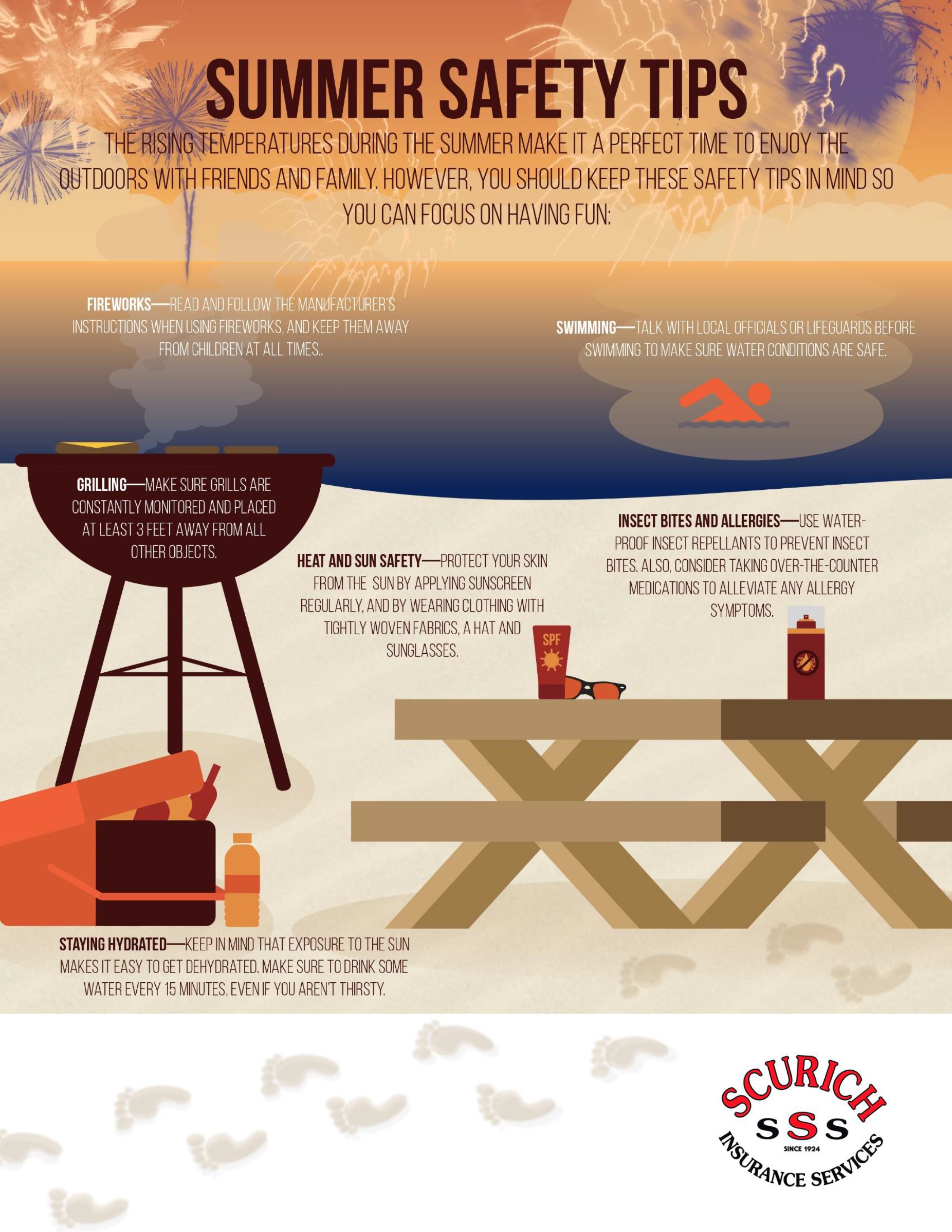
The rising temperatures during the summer make it a perfect time to enjoy the outdoors with friends and family. However, you should keep these safety tips in mind so you can focus on having fun.
Fireworks
Read and follow the manufacturers instructions when using fireworks, and keep them away from children at all times.
Swimming
Talk with local officials or lifeguards before swimming to make sure water conditions are safe.
Grilling
Make sure grills are constantly monitored and placed at least 3 feet away from all other objects.
Heat and Sun Safety
Protect your skin from the sun by applying sunscreen regularly, and by wearing clothing with tightly woven fabrics, a hat and sunglasses.
Insect Bits and Allergies
Use water-proof insect rellants to prevent insect bits. Also, consider taking over-the-counter medications to alleviate any allergy symptoms.
Staying Hydrated
Keep in mind that exposure to the sun makes it easy to get dehydrated. Make sure to drink some water every 15 min, even if you aren’t thirsty.
Read more

Responsible employers in the construction industry know the importance of implementing a safety and health program to prevent workplace injuries. Effective safety programs have seven core elements.
- Management leadership—provides the resources needed to implement an effective safety and health program.
- Worker participation—allows a program to benefit from the workers’ knowledge base and empowers workers to provide feedback.
- Hazard identification and assessment—identifies the root cause of construction injuries.
- Hazard prevention and control—helps employers provide workers with safe and healthy working conditions.
- Education and training—provides workers and managers with a greater understanding of the safety and health program.
- Program evaluation and improvement—verifies that the program is being implemented as intended.
- Communication and coordination for employers on multiemployer work sites—encourages employers and contractors to consider how the work they do can affect the safety of other workers at the job site.
The seven core elements are interrelated and are best viewed as an integrated system. Actions taken under one core element can, and likely will, affect other core elements. For example, the education and training core element supports the worker participation core element.
It is important to achieve progress in each core element in order to benefit from a safety and health program. Contact Scurich Insurance for more information regarding recommended practices for safety and health programs in construction.
OSHA Rescinds Walkaround Memo
OSHA has withdrawn its 2013 “Walkaround Letter of Interpretation” that allowed union officials to participate in inspections at nonunionized workplaces.
The letter was viewed by employers as an attempt by the Obama administration to support and expand union representation to nonunion workplaces. However, OSHA has now withdrawn the union policy language featured in the letter, calling it unnecessary.
OSHA compliance officers may still attempt to include outsiders to participate in a walkaround if there is good cause. One example of good cause would be due to the compliance officer lacking technical or language expertise that is necessary to the inspection. Such cases are rare, however, as OSHA usually provides the needed expertise from within the agency.
Read more

HIGHLIGHTS
- The final rule required employers to create and maintain workplace injury and illness records for at least five years.
- The Trump administration signed into law a bill that invalidates the final rule.
- Employers subject to OSHA recordkeeping requirements must create injury and illness records within six months of an incident and retain these records for at least five years.
IMPORTANT DATES
December 19, 2016
OSHA’s final rule on ongoing employer recordkeeping obligations published.
April 3, 2017
The final rule was nullified.
|
|
On April 3, 2017, President Donald Trump signed into law House Joint Resolution 83 (H.J. Res. 83). This bill nullifies a recordkeeping final rule issued by the Occupational Safety and Health Administration (OSHA). OSHA issued this final rule to amend its recordkeeping regulations and clarify that an employer’s duty to create and maintain work-related injury or illness records is an ongoing obligation. The final rule did not create any additional or new recordkeeping obligations for employers.
The clarification explained that an employer remains under an obligation to record a qualifying injury or illness throughout the five-year record storage period, even if the incident was not originally recorded during the first six months after its occurrence.
This Compliance Bulletin contains information regarding the nullified final rule and clarifies which legal requirements no longer affect employers subject to OSHA recordkeeping rules.
ACTION STEPS
The final rule is no longer valid. Therefore, employers are no longer required to comply with any of its provisions. Employers that were affected by the final rule should review their workplace injury and illness recordkeeping procedures and ensure that they are consistent with the nullification of this rule.
|
OSHA Recordkeeping Requirements
OSHA requires employers to create and maintain records about workplace injuries and illnesses that meet one or more recording criteria. Specifically, employers must:
- Create and update a log of work-related injuries and illnesses (OSHA Form 300);
- Create and maintain injury and illness incident reports (OSHA Form 301); and
- Create and display an annual summary of workplace incidents (OSHA Form 300A) between Feb. 1 and April 30 of each year.
Employers must keep these records for at least five years. The five-year retention period begins on Jan. 1 of the year following the year covered by the records. For example, the five-year retention period for incident reports created on Jan. 23, 2015, June 15, 2015, and Nov. 4, 2015, begins on Jan. 1, 2016.
Penalties for Noncompliance
OSHA has the authority to issue citations and assess fines against employers that violate recordkeeping laws. However, in general, the Occupational Safety and Health Act of 1970 (OSH Act) does not allow for a citation to be issued more than six months after the occurrence of a violation.
OSHA is of the opinion that a violation exists until it is corrected. Therefore, according to OSHA, the six-month period to issue citations and assess penalties begins on the date of the last instance of the violation. For example, if a violation that started on Feb. 1 was corrected on May 15, the six-month period would begin on May 15, and OSHA would have until Nov. 15 to issue a citation.
OSHA also asserts that uncorrected violations are considered ongoing violations, and that each day of noncompliance is subject to a separate penalty.
The Final Rule
According to OSHA, adopting the final rule and amending its recordkeeping regulations was necessary because the previous regulations did not allow OSHA to enforce an employer’s incident recording obligation as an ongoing requirement. In fact, a federal circuit court has held that the former regulations did not authorize OSHA to “cite the employer for a record-making violation more than six months after the recording failure.”
The court also noted that there is a discrepancy between the OSH Act and the regulations, and that while the OSH Act allows for continuing violations of recordkeeping requirements, the specific language in the regulations does not implement this statutory authority and does not create continuing recordkeeping obligations.
The federal court interpretation of the regulations meant that employers were no longer responsible for recording or storing workplace incidents if OSHA failed to detect and penalize employers for omitted recordable incidents within the six-month period. For this reason, OSHA issued its proposed amendments on July 29, 2015.
Impact on Employers
Because the final rule has been effectively repealed, employers are no longer required to comply with any of its provisions. This means that OSHA cannot enforce an employer’s recordkeeping obligation if the employer fails to record an incident within the first six months of when the incident took place. In practical terms, this means that OSHA will have to limit the scope of its recordkeeping investigations to the previous six months, rather than the previous five years.
However, because some OSHA records span entire calendar years, employers that fail to create injury and illness records in a timely fashion risk the possibility of keeping inaccurate records or reporting erroneous information to OSHA. Therefore, employers should not interpret this legislative development as an opportunity to bypass or contravene existing OSHA recordkeeping obligations. |
Read more
